

So you have a set of rhythm flashcards. When you teach students how to read rhythms you might start with the flashcards and chanting so that students only have to focus on one thing at a time. You only use your flashcards for group sightreading. The students are getting tired of flashcards, you’re getting tired of flashcards. What do you do?
Play games.
Rhythm flashcards can be used for so many fun games and can help liven up any performance based classroom. If you don’t know where to start with games and fun ideas for your rhythm flashcards, then you’re in the right place. Keep reading!
- Add Body Percussion
This assumes that you’ve taught students the four basic levels of body percussion, or have at least taught them a body percussion piece in the class beforehand. All you need to do is hand out copies of rhythm flashcards (I always have rhythms that I’m targeting for assessment) and give them your parameters.
By parameters I mean, do your students need to use the flashcards in a certain order? Do they need to put the flashcards in a certain form (AB, ABA, Rondo)? Are they only allowed to use two levels of body percussion or can they use all four? Do they even have to use the flashcards or are they allowed to compose from scratch as long as the rhythmic requirements are met? Lot’s of things to think about.
After Parameters have been set all you need to do is see if the kids are performing the rhythms correctly and with a steady beat. At the end of class it’s really fun to have the kids perform all of their compositions one right after the other to see how creative they were with all the same instructions.
- Have a Rhythm of the Day
Rhythm of the Day, Poison Pattern, Poison Rhythm, it’s all the same game! But the students still have so much fun and they want to win against the teacher. There’s nothing students love more than beating their teacher at a game, and there’s nothing I love more than the students getting specific, targeted practice on a rhythm.
To play all you have to do is take your set of flashcards and declare one is a Poison Rhythm. Have students perform and sight read this rhythm from the flashcard so that you know they can perform it. Once you’ve determined that they know how to perform the poison rhythm then announce that it is off limits. From this point forward, if students perform the poison rhythm when it is presented you get a point. If they see the poison rhythm and do not perform it, they get a point. The first to three wins.
- Compose with Flashcards
Getting students to compose music is a huge part of the national music standards, but I think it’s probably one that we forget to work on a lot. Flashcards can help us scaffold composition with our beginner musicians because they give the kids a nice comfy box. The box can be expanded later, but in the beginning they need a small box.
Assign several flashcards with familiar rhythms and see what students can do. This can lead to discussions about what types of rhythms made us feel like our compositions were complete and which rhythms made us feel like we needed to keep going. When you teach students about form, you can have them create a piece with multiple sections and discuss how they think each section complemented the other. I love composing with flashcards because it can lead to so many reflection opportunities and it provides the students with lots of choice and voice.
- Add a Melody
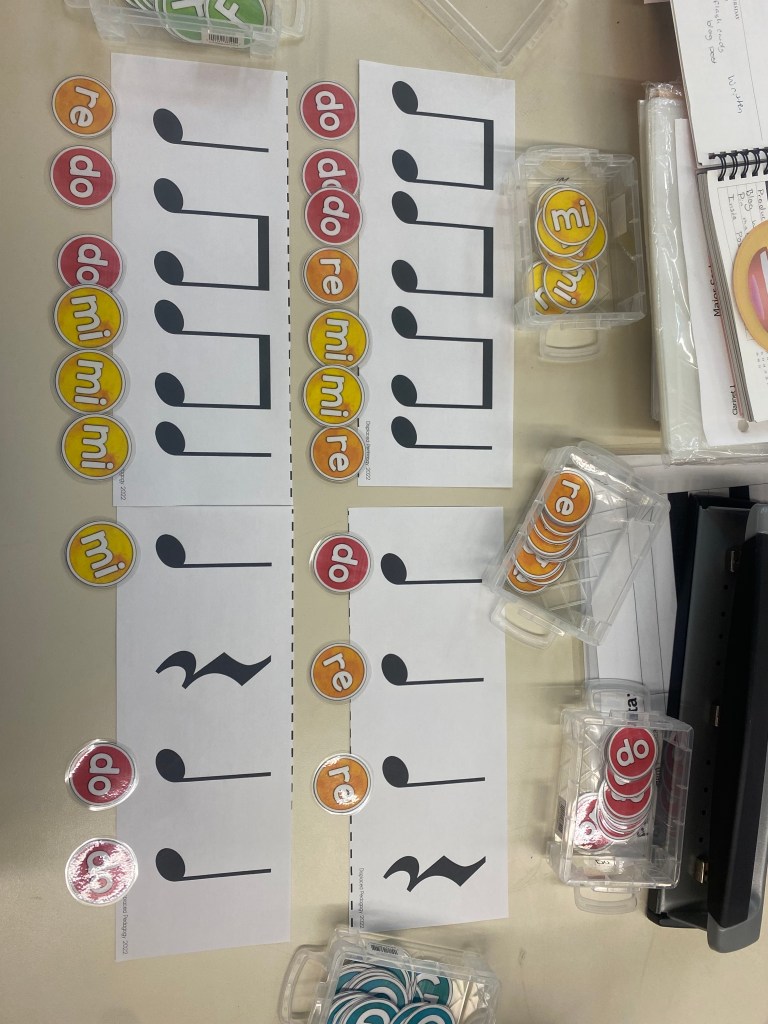
Similar to adding body percussion, adding a melody can be a great way to use rhythm flashcards. When we do this I start with a predetermined rhythm that I don’t let students change and a pitch set that I want them to focus on. This is also a sneaky way to get your band kids to practice specific notes.
Once again, you need to set specific parameters for the compositions. And when adding the melody I would highly encourage not letting them have a say in rhythm as each new note has a specific role that it plays in the scale. But they still get lots of practice on the rhythms because they’ll have to make adjustments to the melody a few times.
As you can see in the picture above I used solfege dots (I got these from Make Moments Matter on Tpt) to denote what solfege I wanted the melody to follow. They are super handy and can be found here!
- Play Four Corners
I love the game Four Corners! My students love it too. They love anything where they get to move around the classroom and not sit down for a few minutes. To set up four corners I place a card in each corner of the room that’s labeled A, B, C, or D. On the screen in my room I have a powerpoint with the rhythms and answer choices. I pick one of the rhythms to perform for the students, then they have to decode the rhythm in their head and move to that corner of the room. If they are correct then they get a point and get to brag to their friends. This continues until all slides have been gone through.
- Quiz Quiz Trade
Quiz Quiz Trade is a Kagan Cooperative Learning game. I am required to use Kagan strategies in my classroom, so I’ve had to finagle and work with them a lot to make it something that middle schoolers would actually use.
The first step is to distribute flashcards to each student. Students will stand up and find a partner. Once they find a partner, student A will quiz student B on their flashcard. Student A will either praise Student B for providing the correct answer, or will coach student B to the correct answer. Once this process has been completed student B will quiz student A and the whole process repeats. After both students have been quizzed, they will trade flashcards and find a new partner.
With this one you do need to watch and make sure that students are actually finding new partners and not just moving around the room with their one partner. I also add that students must check in with me for Quiz Quiz Trade one time, so that I can assess them.
- Headbands
Headbands is a classic game where one person wears a rhythm on their head and the other people help that person guess what is on their forehead. In the beginning of the year I will have students perform the rhythms on the headband and I will guess what rhythm is on the flashcard. This lets me know if my ensemble can perform all together and accurately. As students get more advanced, then they can start being the person wearing a headband. This really works the ear training and decoding skills!
- Gallery Walks
Anything that gets students out of their seats is a favorite of my kids. They love walking around and getting to actually talk to their classmates while we are in class. I use gallery walks every few weeks to help them scratch this itch and collect something to grade and use for interventions.
To set up a gallery walk all you have to do is tape a flashcard to the walls of your room. I would recommend at least 6 and no more than about 12-15. Students will walk around with a piece of paper that they numbered or an accountability sheet that you made and they will record their responses for each flashcard.
I will stipulate, make sure that you know where each number is so that you can help students if a flashcard falls off the wall. Make a key for yourself so that you can grade them easily. If you don’t want to make your own gallery walk I am working on making gallery walks for all levels of rhythms. You can get these from my Tpt shop!

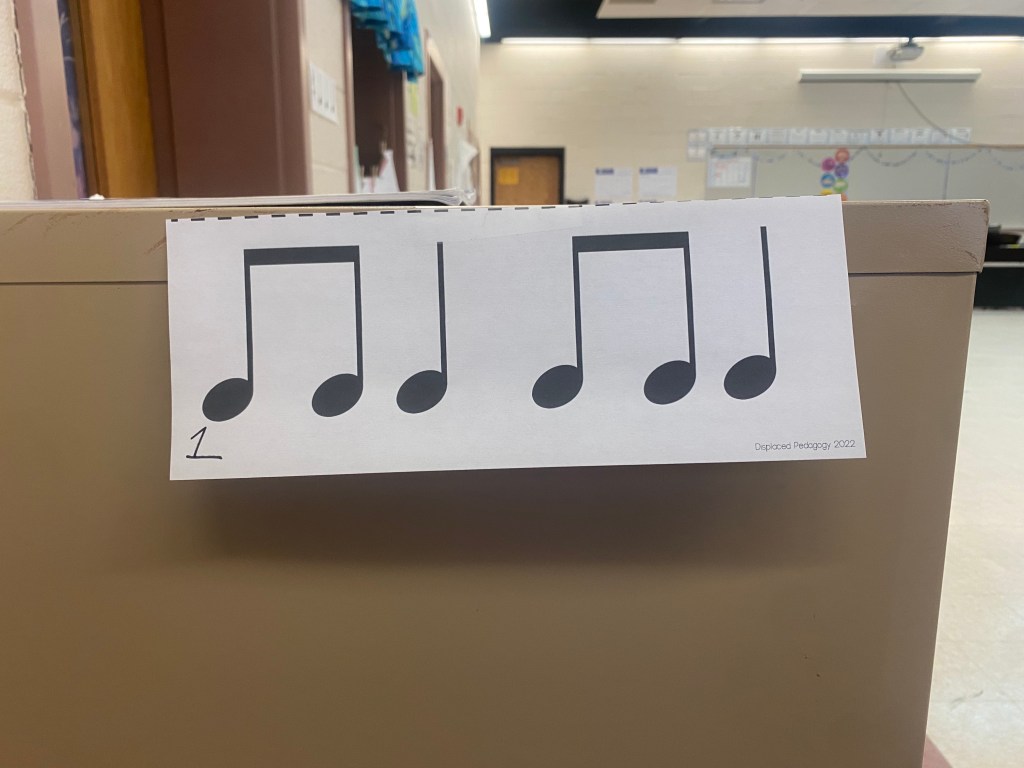
You can also visit my Tpt shop to get FREE rhythm flashcards. All of my common time rhythm flashcards will be free! I am working on getting these uploaded as quickly as possible and I am working on making sure that they can be used for beginners all the way to advanced groups.

 Displaced Pedagogy