Home
-
How to Make your Music Field Trip Easier

Field trips can be stressful. You have to coordinate budgets, calendars, and all the people so that the day goes well. As the lead adult in the room you also have to select and coordinate all the other adults helping you chaperone your groups. You know you need to give your chaperons certain things so that the day runs smooth and you want prepared chaperones that your students enjoy, so what do you do?
You create The Chaperone Backpack.
What is a chaperone backpack?
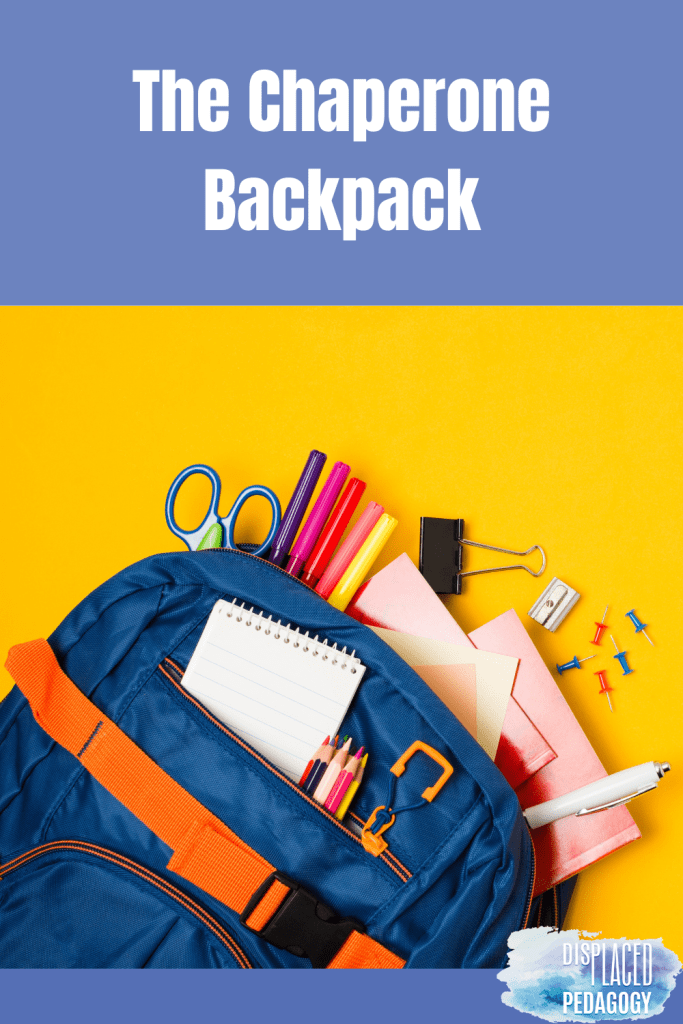
The chaperone backpack is quite literally a backpack you give to the (or all) of the chaperones for your field trip. You may or may not need one for yourself depending on the type of field trip. For instance, if you’re traveling to an amusement park for a performance; take the backpack. If your field trip is to choral assessment, then maybe you don’t also need the backpack.
I got this specific backpack from Walmart because it was cheap, but relatively sturdy and its rather gender neutral, in case you need to worry about that. Its expandable and has padding on the straps and back for comfort. And as I was cleaning it out I also discovered that the side pockets hold an entire 16 ounce water bottle!
What goes in the chaperone backpack?
In my chaperone backpack I put all of the following things:
- Rosters
- Field Trip Permission Slips
- Emergency Medications (if applicable)
- First Aid Kit
- Hand Sanitizer
- Deodorant (I taught middle school)
- Gallon Ziploc Bags (for assessment I had my chaperone take all the things students could loose ex. wallets, phones, smartwatches, etc. and place them in bags marked by grade level so we wouldn’t have anything to make us late getting back to school)
- A Schedule for the Day
- Maps (if applicable)
- Student Contacts
- A Sign Out Sheet (I would recommend only one person have this so that one person can help keep an accurate student count)
What did my chaperones think of the chaperone backpack?
My chaperones from assessment both said that they enjoyed the backpack system because literally anything they might have needed was easily accessible and just handed to them in the backpack. Both teachers that I had asked to help chaperone assessment brought their own personal bags just in case, but when it was time to go they just locked their bags in my office or in a cabinet in their classrooms.
One of my lovely chaperones said that he loved that I handed him everything we would need for the day in a bag since he isn’t’ a musician and had never been to that type of event before. He also loved that I made all the students turn in their phones before we entered the building for assessment and that I had a different Ziploc bag for each grades’ phones. He said we had the only group of students all day that was paying attention to other groups performing and he made sure to brag on our students to them and to me.

-
Displays you Need in Your Music Classroom

At the time of writing this, I have three weeks until I go back to school for inservice and four weeks until I see students again (yikes!). So I’m starting to think about my own classroom setup and what I need to put up on the walls. If you are a new teacher and don’t know what you need then I recommend that you keep reading to gather some ideas.
Now I do not have pictures of what I did in my classroom last year, currently. However, I will have pictures soon!

Make sure students can actually see it
Whether you are teaching elementary and have students that are three foot tall kindergartners and 5 foot tall fifth graders, or you teach middle school performance ensembles and the students aren’t moving around to see your walls that much, you need to make sure that students can see what’s on the walls or it’s kind of pointless.
In my classroom I focus on educational displays and I have performance ensembles. I also teach in a high needs area where one of the needs is glasses. Many of my students need glasses and simply can’t afford them. So in all of my classroom decor packs the focus is on making sure that the text is very large and legible from across the room. I even had my percussion students tell me if they could see the word wall from their seats in the very back before I made the design permanent.
If your students can’t see the words on the word wall from where you’ll be asking about vocabulary the most you either need to rethink where the word wall is or think about where they’ll be doing vocabulary activities.
Obviously that rule goes for all content besides vocabulary, but that’s the example I have in mind right now.
Have Educational Displays
I primarily have educational displays in my classroom. I teach band and choir so there’s like one giant word wall for vocabulary for both classes, then there are smaller vocabulary displays around the room for content specific vocabulary.
In addition to the word wall I also have a solfege ladder displayed (which I use for both groups), an instrument family display (still vocabulary?), and a data display. I have to have the data display because my school district requires one. If your school district doesn’t require one then awesome, because it can be a bit of a pain.
I also keep a few sets of mini anchor charts hanging up for my students so that they can use them any time they need. I simply just don’t have enough space to keep anchor charts up all year.
Have displays where you can build community
My favorite displays for community building are made of student artwork. I tape up all of the artwork that students give me throughout the year behind my desk, so that I can just turn around and look at it when I need a boost on those super long days.
This year I really want to try to print out pictures of things that the students do at our community building events (also new this year). For more information on those check back in later; I promise I’ll write a post about it.
Have Some Admin Friendly Displays
So administrators aren’t exactly knowledgeable about music. That’s not a secret. I got to the point where I just decided to hang student work in the hallway because then I didn’t have to have a monthly theme on my hallway bulletin board. However, administrators don’t always know what the students were supposed to be doing on the assignment you are displaying.
I liked showing off rhythmic dictation assignments last year because dictation is a high level skill. Since my administrators don’t know what musical dictation is, I put a piece of paper at the bottom of the bulletin board and explained all the skills that were involved in dictation and what the process looks like.
My principal caught me in the hallway and specifically mentioned that I must be doing a great job with the students if they can do something so advanced with them. So admin really like the student work displays, and helping them understand what they’re looking at goes a long way!
In summary…
There are a few different types of displays that you need to or should have in your classroom as a teacher. I would recommend having more educational displays than anything else, at least one community building display, and an administrator friendly display that you rotate periodically.
If you don’t want to fuss with making all the classroom displays by yourself I have several items in my Tpt store. I am working very hard to get the three product lines finished before the school year begins. If you purchase the bundles now you get any new uploads for free! You should go check it out! -
Tips for Creating an Awesome Music Teacher Resume

Whether you are looking for your first job or a new job a great resume and cover letter is a must! Your resume is either your very first, or one of your first impressions with your new school, so it has to be good in order to get that interview to make a better impression. That means you need all the correct information in the correct order and formatted in a visually pleasing manner.
I’ve gone through the wringer writing my own resume and now I have friends who come to me to help them write resumes because they know mine is really good. I’m going to share all the advice that I have to offer in this post and hopefully your resume will look amazing after reading this blog post.
The first half of the blog is going to go over what information you need to include and in what order, the second half is where I will give you all of my tips about formatting the resume so that it gets read.

What information should you put in your resume?
Education
Relevant experience
Leadership experience
Relevant skills
Awards and honors
Skills
Publications/ conference appearances
What order should your sections go in?
New Grads
Education
Relevant experience
Leadership experience
Relevant skills
Awards and honors
The reason that your sections should go in this order is because you just got out of school. You may not have very much relevant experience, and if you do it wasn’t a long term commitment. Administrators will also know that you’re fresh out of college and will want to know what type of relevant course work you completed.
Relevant experience for us music teachers is anything from band camps, private lessons, and summer camps. Make a list of all of those that you did and the year(s) and locations of each thing.
Were you in a fraternity, sorority, or other student organization? Talk about it, especially if you had a leadership position at any time while you were in college.
Relevant skills include knowing how to use GSuite or the Microsoft Suite effectively. Maybe you are a master at creating and maintaining budgets, maybe you weren’t good at planning instruction, but you were great at keeping students engaged in their learning. There are so many skills that you could pick from as a music teacher.
For Awards and Honors I wouldn’t list every single scholarship you got. List any music specific scholarships you were awarded. And then list honors you received through your student organizations or academic department.
Seasoned Teachers
Work experience
Education
Certifications
Leadership roles
Awards and honors
Skills
Publications/conference appearances
So the sections are flipped around a little bit to reflect that you have had a job now. List any and all jobs you’ve had in your entire career, we will brag about how awesome you are under each job heading.
Education will be similar to when you were a new teacher, you don’t have to go into as much detail because at this point admin cares way more about your practical experience than anything else.
List any and all extra certifications that are related to your job. I will be finished with Orff-Schulwerk Level III and will replace “Orff-Schulwerk Level II” with “Certified Orff-Schulwerk Instructor.” If you have the Google Level 1 training also list that. I personally wouldn’t list all the health and safety training that your school makes you do because that’s pretty standard stuff. But be sure to list anything that is music specific or isn’t a standard thing that almost every educator get certifications for.
This goes without saying, but if you were on any committees at your school or within a professional organization please list that. Treat this as a secondary work experience section.
For awards and honors as a seasoned teacher I would keep it to things that were awarded for a whole school year. For example, I was awarded Teacher of the Month for the month of February at my school. I am not going to list that on my resume because it isn’t a teacher of the year type of thing which is a bit more impressive. I will list that I was awarded several grants for professional development by my professional organizations, if I am selected as the Middle School Music Teacher of the Year by my MEA district I will list that. My cooperating teacher was just awarded Elementary Music Teacher of the Year from my state’s MEA, so that’s a real big deal and needs to be talked about.
If you’ve written anything that got published in an academic journal or industry journal then list the title and all that fun stuff. The same thing goes for any conference presentations that you’ve done. Listing these things on your resume shows that you are a true expert in the field and that you are in innovator in the field. We will go over formatting of all of this stuff in the second half, but seriously, list this kind of stuff!

Formatting Your Resume
Formatting is really important because you only get one page to fit all of this super important stuff. If your resume is too long or too text heavy it won’t even get read. And yes, there is currently a teacher shortage, but that’s only making admin and SBDM councils more weary and tired. Keep the resume light and text, but impactful.
Put your info in the page header
This is my protip because I have quite a few leadership roles, certifications, and other things that I would rather have take up space on my resume instead of my name and address. This is also helpful when your resume goes onto your back page; your personal information is on both pages automatically.

If you’re like me and have a lot that needs to go on a resume then this is a great “hack” and all you have to do is go to “Insert,” “Headers and Footers,” “Headers” and start typing. To insert the black circle like I did you need to go to “Insert,” “Special Characters,” then type “Circle” in the search bar.
Avoid large Chunks of text
No one is going to read all of that. The hiring committee will probably be interviewing people all day and has probably been looking at resumes and cover letters all day. They will not read your resume if if has giant chunks of text in it. Please break it up and create some white space.
Pick one font and stick with it
Between bolding, underlining, italics, and making slight changes to font size you truly do not need any more than one font. This will make your resume easier to format as well because you don’t have to remember which font went where and how you formatted it to look like a certain way. Creating a resume can also be stressful, so this way you wont have to spend a bunch of time wondering if the fonts look nice together.
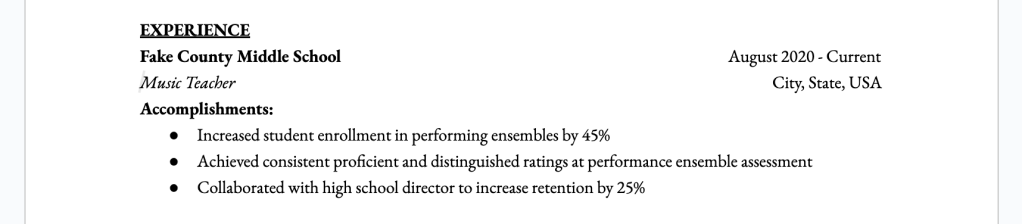
In the picture of my resume above, you can see that everything was done in one font and I just changed the text formatting a little for each different thing. Once I have established this formatting pattern once I’m just going to keep it nice and consistent through the entire resume and the bold text will keep drawing eyes to the big, broad information that is necessary.
Use “Power Words” to make a large impact
Which sounds better?
- Facilitated student learning of 10-minutes of music and movement for local, district, and state performance assessments.
Or
- Taught students music for 10-minute marching band show.
I bet you picked number one, didn’t you?
I don’t know why, but people reading resumes love “legal-ese” even though no one in the room is a lawyer. I don’t know all the specifics about power words, I just know that they are important and that they should come at the beginning of the bullet point. For an excellent guide about power words to use click here.
General considerations
One page or less
The shorter the better, so to speak. If you have one page all on the front then thats great. I had to go onto the back page, which people hardly look at, so i keep my least important stuff the back. The stuff on the back is still important and shows a more complete look about me as a teacher, so thats why I keep it there; however, it’s not going to be make or break if no one looks at it.
Use bullet points (but not to many)
The rule of thumb that I am aware of is to include 1-3 bullet points to explain what you did in a role. So don’t just list that you had a job. List that job then brag about 1-3 major accomplishments from that job.
Reverse chronological order
This is standard across all resumes in all fields. Every section needs to be in reverse chronological order! That means that your student teaching experience should be first under relevant experience new grads! Unless of course you have a summer camp position that you will be working after summer camp.
If you have two positions that ended at the same time (two leadership positions in different organizations) then you would list the one that started later, and underneath it the position you started earlier.
Have someone else proof it… then ask someone else
When I made my resume for grad school applications I had my advisor look over my resume. He absolutely tore it to shreds and told me to edit everything and bring it back to him.
I made the edits.
I took my resume to him again.
And he tore it to shreds again. Then he said to take it to my research advisor (i did two different undergraduate research projects; she was my mentor for both projects)
I made the edits and took my resume to my research advisor.
She also tore my resume apart. Then said to make edits and take it to the instrumental head of department at my university.
So I made more edits. I took my resume to the third different professor. I waited anxiously as he edited my resume even more. He was correcting all of the tiniest details and making all of the edits using english language rules that I didn’t even know existed!
But he said that my resume was really good and that I needed to make the edits and take my resume to the university career center for one last look.
So I made probably my 5th set of edits to this resume. I would like to say it wasn’t bad to start with, but at this point I was so tired of worrying about formatting and punctuation and font size that honestly, maybe my resume did start out that bad.
I wouldn’t know how bad it was without these people because this was my first resume that I’ve ever written! Anyway, this isn’t the point. I made more edits. I took my resume to the career center on campus.
The career center lady said “wow this is a really good resume! Which of this stuff is from high school?” When i responded that everything in my resume was from college she was genuinely impressed. I presented her with a one page front and back resume that was exclusively college experiences. She had no notes, but she gave me a booklet with other formats to explore for my professional resume, and I have never been more relieved!

-
Canva in the Music Classroom
If I’ve learned anything from the state music conferences in recent years, it’s that music educators have to be our own press team. This past school year I became the PR team for the middle and high school in my district. I plan on offering my services to the elementary schools this year, but I haven’t made contact with those teachers yet because the end of the school year was crazy town!
In becoming the PR department for my own program and another music program in the district I learned a lot about writing a good newspaper article for our local news paper and I learned that I need to be more specific when I ask trip chaperones to get pictures of the groups while I retrieve scores. But that isn’t the point of this blog.
The point is to introduce you to the wonderful tool that is Canva. There are so may ways that Canva can be used by music teachers, or teachers in general. These are just a few of my favorite ways to use Canva in my job and I’m sure that you or I will find even more ways too!
Make Social Media Announcements
If you have a social media account for your band or choir then this will be really helpful when sharing information. We live in a very visual world, so making an immage to share an announcement will help catch your audience’s (your students’ parents) attention. Don’t believe me?
Think really hard about anything you’ve had to read on social media. Did you read the super long post from your kids school to get all the details, or did you just skim it for the key points? If you’re reading a blog post about how to fix something, do you rely on just the text, or do you use the pictures to help you know you’re doing the correct thing?
And this is a niche issue, but if you bought a brand new marimba with ESSER funds like I did, you were probably relying on pictures to make sure you put the new marimba together correctly because those directions were not great!

My point is, pictures are super helpful and they get the point across quickly. Use them!
I’ve seen directors create graphics for recruitment, band camp announcements, student shout outs, and to communicate with parents on field trips. The graphic above is one that I used to grab attention on a post that linked to a few local summer music camps.
There are so many great ways to use Canva for your social media announcements in your classroom.
Create engaging slides for announcements or content
I don’t know about you, but I like to have slides to follow along in my lessons to help me stay on track and help make sure that the lesson flows. If you want to avoid the boring slide presentation blues, then I would suggest Canva.
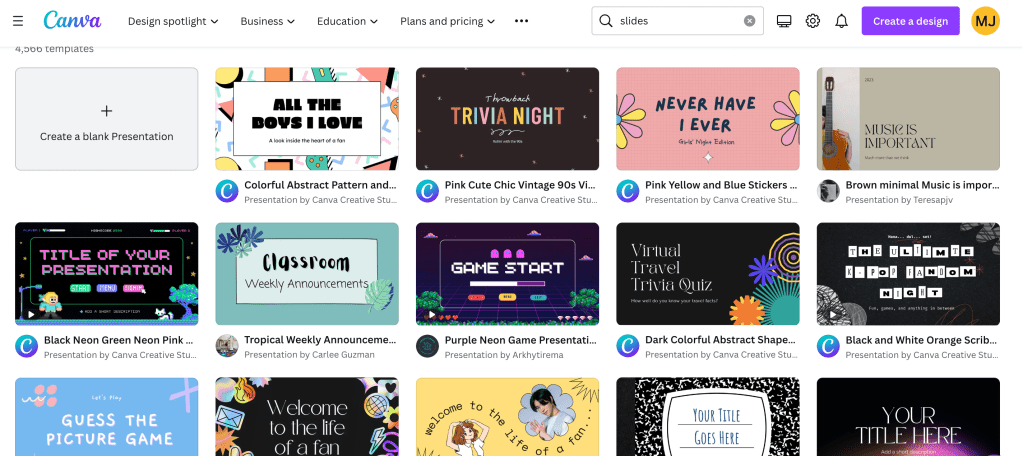
Canva has a ton of engaging elements that you can add to your slides such as animated arrows to point out important information. You can also upload your favorite countdown timer videos form YouTube and embed them into your slides. Canva has a few countdown timers, but there isn’t a lot, so I would still go with a countdown timer from YouTube.
Create your own Meme Templates
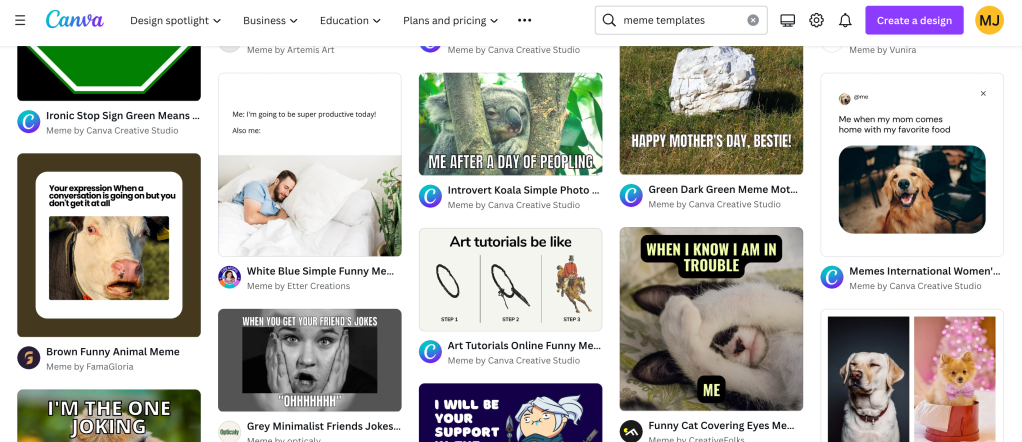
This is super easy to do in Canva. All you have to do is upload a picture into a file for whatever size paper you’ll print the memes out on. Or your template should be formatted to fit the social media pages that you may have for your class. Show the students how to log in to Canva and how to duplicate pages, also show your students how to change the text in a text box. Then you’ll have tons of memes for all your meme needs.
You can also search for “meme template” in Canva, filter for free templates, and then let students edit them.
Make Reward Certificates
Canva has tons of templates for you to choose from where all you have to do is hit duplicate then type in names. You can even edit colors and fonts to suit your specific style or to match your school colors.
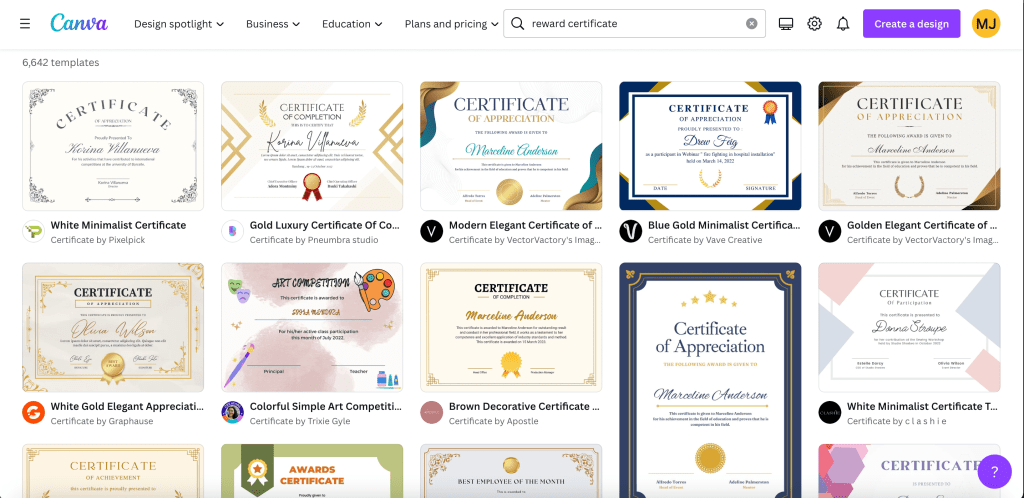
It also wouldn’t be difficult to make your own template in Canva.
Make concert Posters
I am still playing with this one because I didn’t make concert posters last year. And when I did make concert posters is was on an 8.5 x 11 with arial font and I only taped it in the front office. But I am committed to stepping up my game this semester and this is what I am drafting right now!
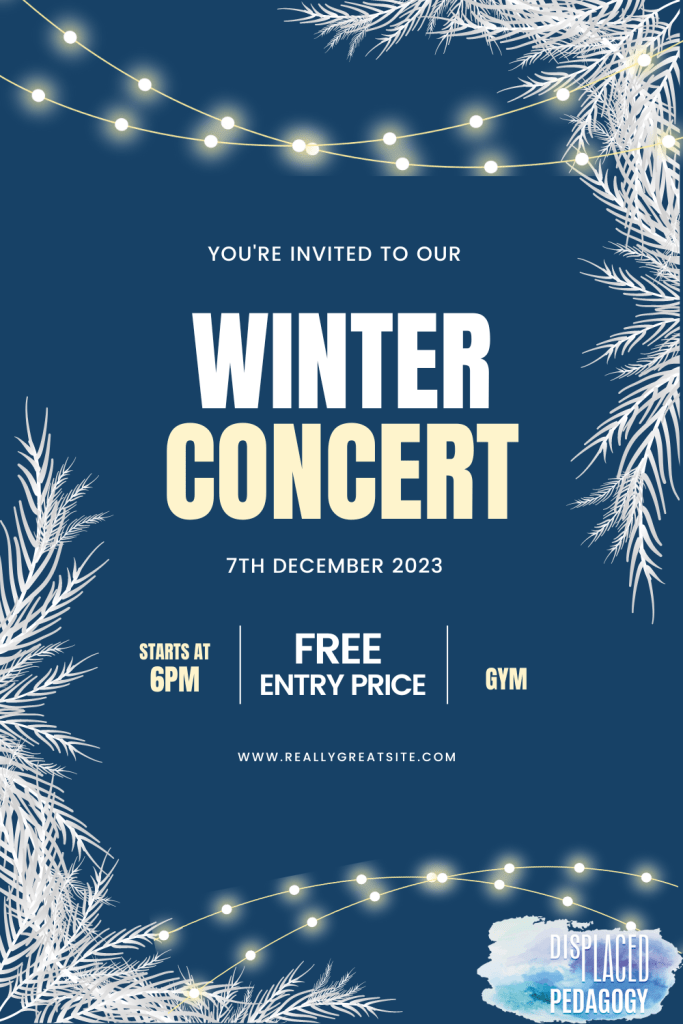
Its a little wonky because I had to resize it from its original size to make an image for this post, but it’s a HUGE upgrade from last years piece of copy paper. Also the concert poster wont have my business logo on it…
But once again, Canva has templates for these and all I did was type “winter” into the search bar and filtered out for a poster that I liked. I changed some information and BOOM, a beautiful concert poster for the winter concert that I made in June.
-
Life Lessons from “The Boy, The Mole, The Fox, and the Horse” that We All Need to Hear

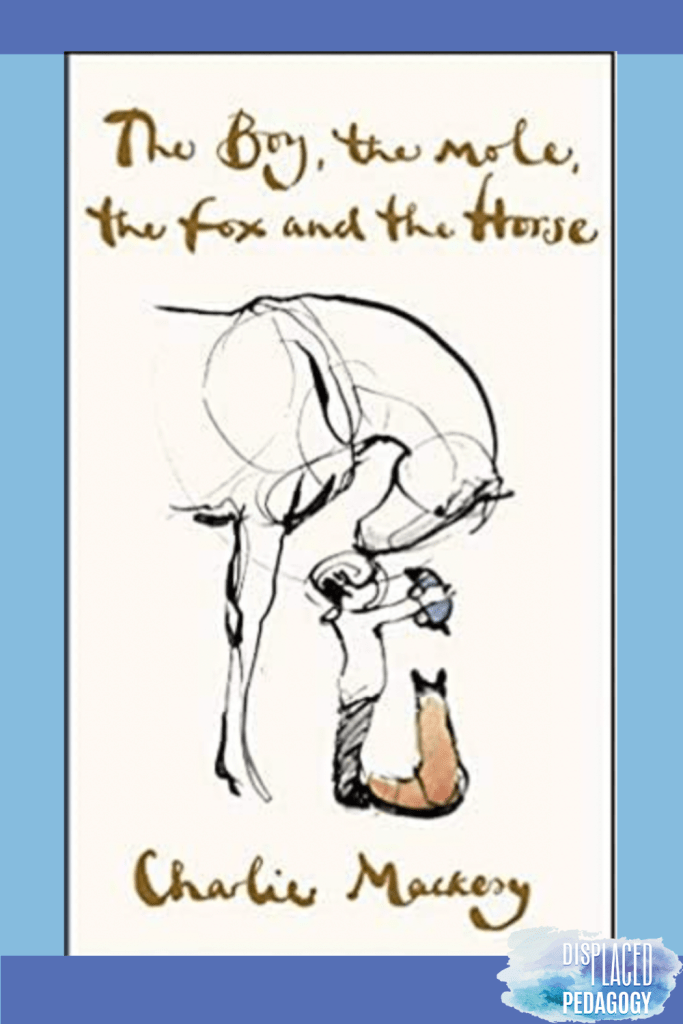
Let me begin by saying that this is not an affiliate post, so if you decide to purchase the book I make no money. I just really love this book and want to share it with all of you, like I share it with my students.
“The Boy, The Mole, The Fox, and the Horse” was recently gifted to me by the mother of a close friend. She is the type of woman who radiates warmth and positivity and who makes you feel like you are being wrapped up in a soft, fuzzy blanket the entire time you are in her presence. She wrote a darling note in this book and I’ll be honest, I almost cried when I read it. I held back the tears welling in my eyes because I was at said close friend’s house kicking off the summer and I didn’t want to be emotional.
As I am writing this I have shown a few other close friends the book and have been showing certain students pages that they need to see. So yes, it is summer break, but I am working at my school’s summer school and I see a lot of my students there because they don’t want to be at home.
The book by Charlie Mackesy centers around a boy who asks lots of questions and a mole who likes cake. They journey together and find a fox, whom the mole frees from a trap at the potential risk of his own life. The three later find the horse, who is very comforting to the trio.
Mackesy uses a messy style to this book. Nothing about the book is pristine or perfect as nothing in life is. At one point Mackesy incorporates some mess that his dog made walking over the pages and a tea stain into the book.
Asking for Help is Brave
This past year was the first time I ever took my band students to our local performance assessment. I read all the guidelines and all the rules before we went and I was positive that I knew every little thing that would happen and that I had prepared my student effectively.
Then came sightreading.
Now don’t get me wrong, I had been practicing sightreading with my groups and I knew that all of my kids could sightread confidently. But I misinterpreted the sightreading regulations for middle school band. We were going as class A (the class for beginners in their first year) and the regulations quite literally said “very easy.” My interpretation was that it would be a unison line from the back of a method book or something in the same range.
However, they meant “very easy” band literature. All the grade half music from JWPepper is class A essentially. They were not prepared for that and we didn’t do as well as we could have. But if I had just asked a more experienced band director who has taken plenty of groups to assessment then I would have known what to actually expect and I would have prepared my students better. I didn’t ask for help because my ego got in the way and it never occurred to me to double check with another teacher because I was afraid of looking like an idiot. But it costed my students greater success.
The Truth is Everyone is Winging It
I remember grading student work my first year of teaching. My thought in the middle of grading this stack of work was, “Who left me in charge of this?” “Why am I allowed to assign student grades?” “Am I really capable of making a curriculum and teaching the kids something about music that they might remember?”
It wasn’t until a year later when I was talking to my teacher friend in the front of the building that I discovered it wasn’t just me that had this feeling. He had that feeling too! A wave of relief washed over me as I realized that I wasn’t the only teacher in my building that felt like I had no idea what I was doing.
I think this is a great life lesson to learn because the truth is that none of us, or our students have any idea what we are doing. You don’t learn what you’re doing until you’ve had a lot of opportunities to figure it out.
I finally feel better about most aspects of my teaching practice and I aim to keep improving on certain areas each year.
Comparison is the Thief of Joy
Too often we get lost in the sauce of competition. We see our groups get proficients and other groups are getting distinguished ratings. The director in the next county just received a huge grant for instruments, your teacher friend in a different state got a new sound system for their program, and your middle school colleague just recruited one third of the incoming class into their ensembles classes. Whatever it is, teaching music will always feel like a competition.
If you keep comparing yourself to the teacher down the road or across the state, then you’ll never get to revel in all the fun and wonderful things that you’re doing right in your classroom with your students.
Focus on What is in Your Control
Deadlines, concert dates; all of these things are largely out of our control. However, we need not stress over all the deadlines and instead focus on what we can control to prepare for those deadlines. The chips will fall where they may at the end of the day and all that matters is that we tried. Directors, we need to focus on making sure students are having a good time while we have them chase for success or they will not come back to us from year to year.
In order to remedy the concert prep stress and make sure students still have fun I recommend making rehearsal plans for your concert pieces and unit plans for the musical elements you have to teach. A well executed plan will always be appreciated by your students even if they don’t know it. You’ll enjoy the plan as well because it’ll give a purpose to each of your classes instead of the typical listen and react model. (There’s nothing wrong with listening and reacting, but I am a firm believer that it shouldn’t be what you do every day).
Focus on what you can control to reach the outcome that you would like.
-
How I Organize My Teaching Materials

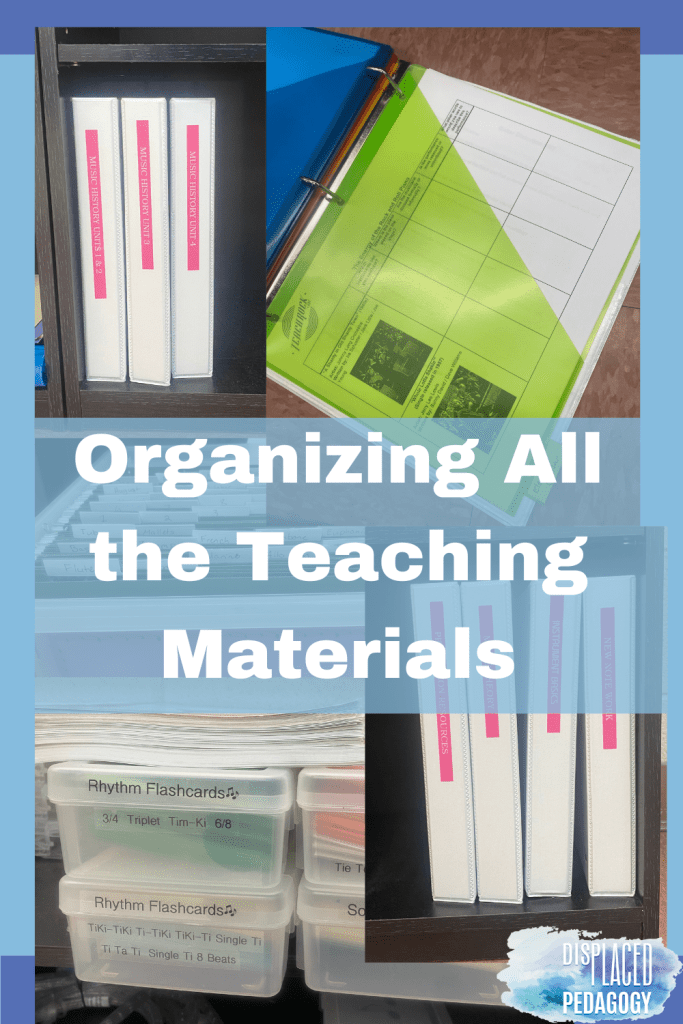
If you’re like me and teach all the things then you definitely have a lot of “inventory” in your classroom. It’s taken me well into my third year to figure out how to organize all of my stuff so that I have a more functional classroom, so today I am sharing how I organize all the things so that you hopefully don’t take as long as I did to get organized.
Binders
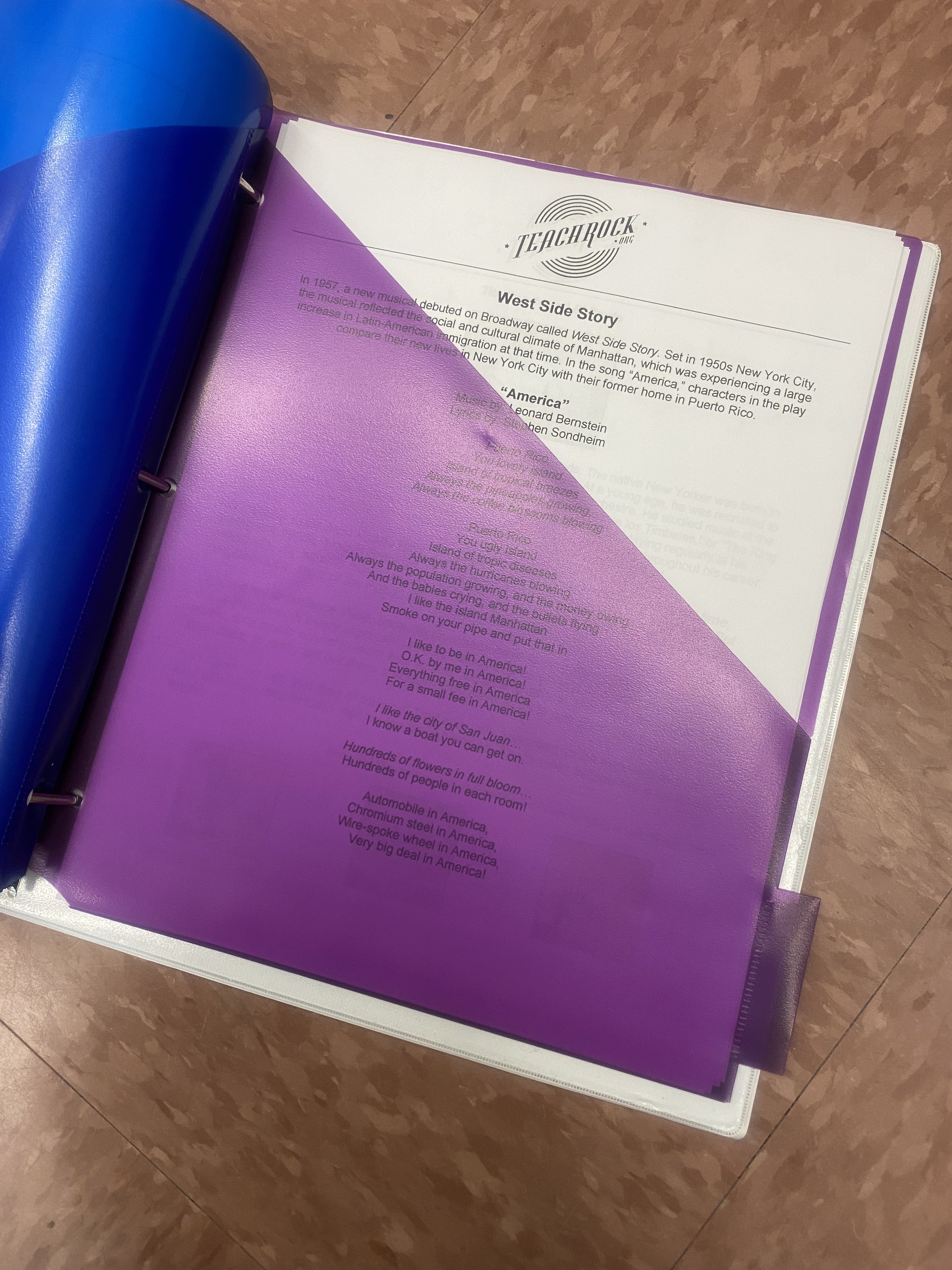
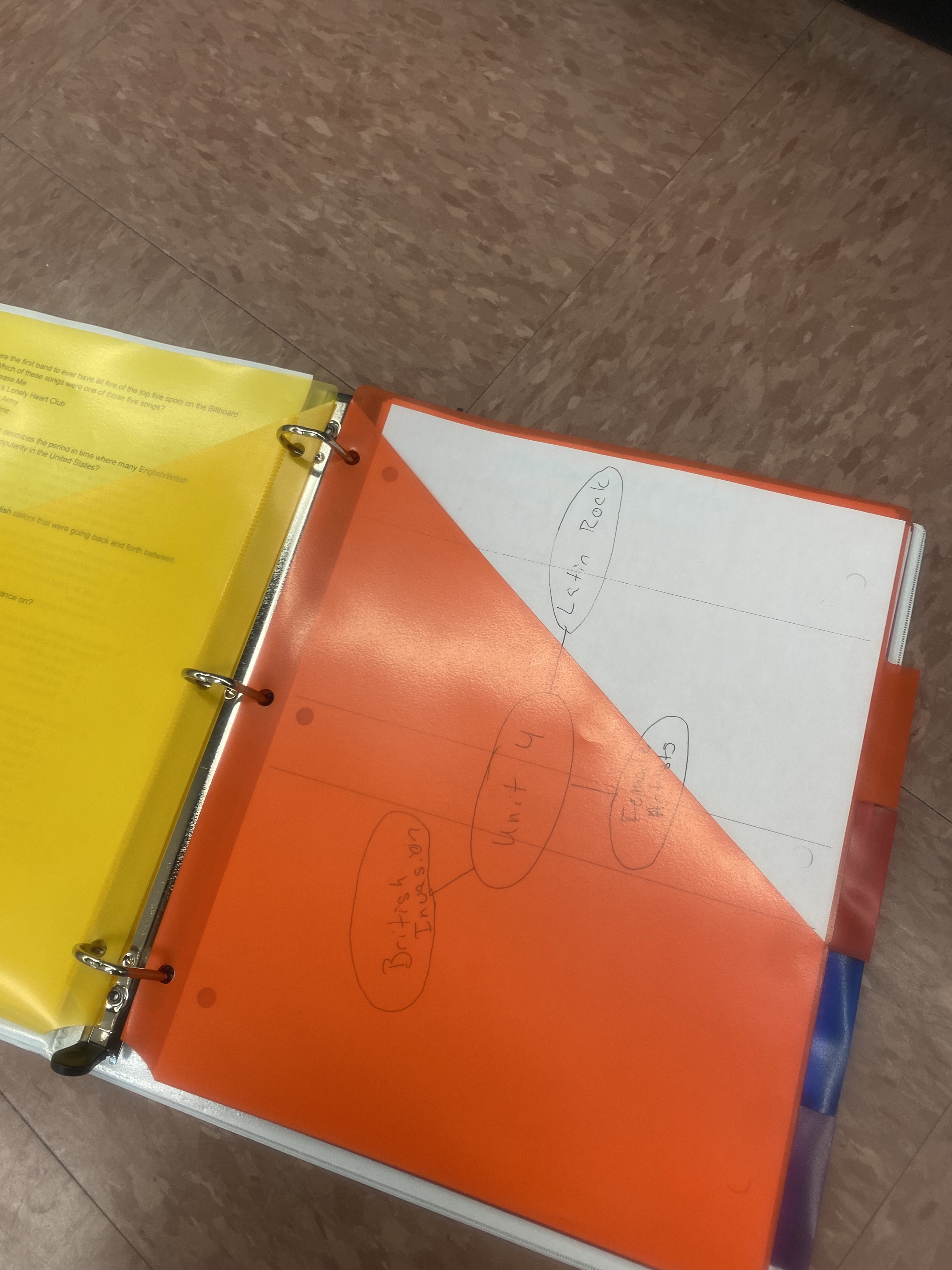
I have recently found out that binders work the best for me to organize papers that I give my students and worksheets that I use. In each binder I have tabs to help organize into smaller categories.
My music history binders are organized into units with each tab being labeled as tests and quizzes, unit long documents (mind maps, KWL charts, etc), then the tabs are labeled with general topics during the unit. I am using the dividers with pockets so that I don’t have to hole punch pages or bother with page protectors. It’s a super fast and easy system.

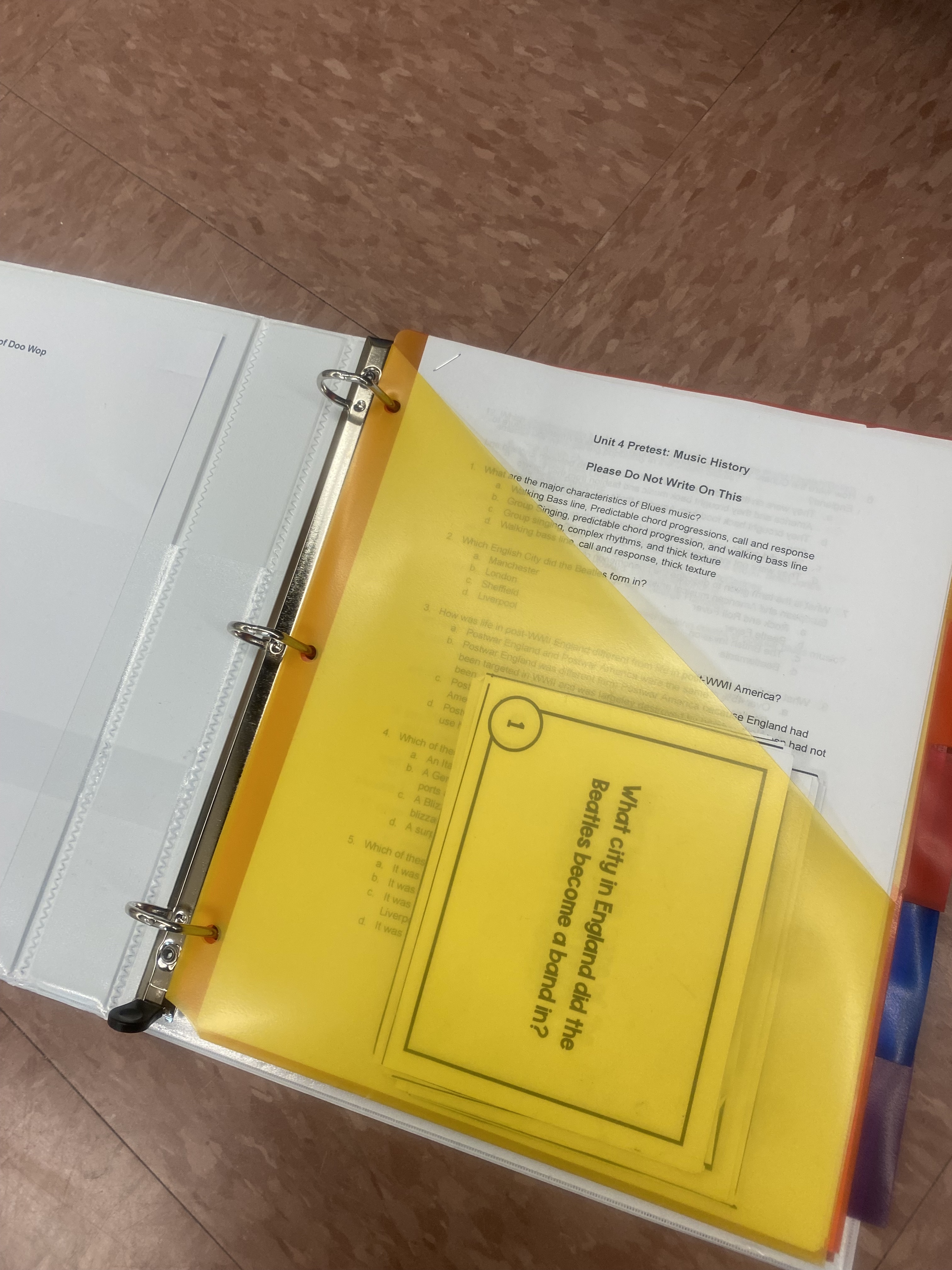
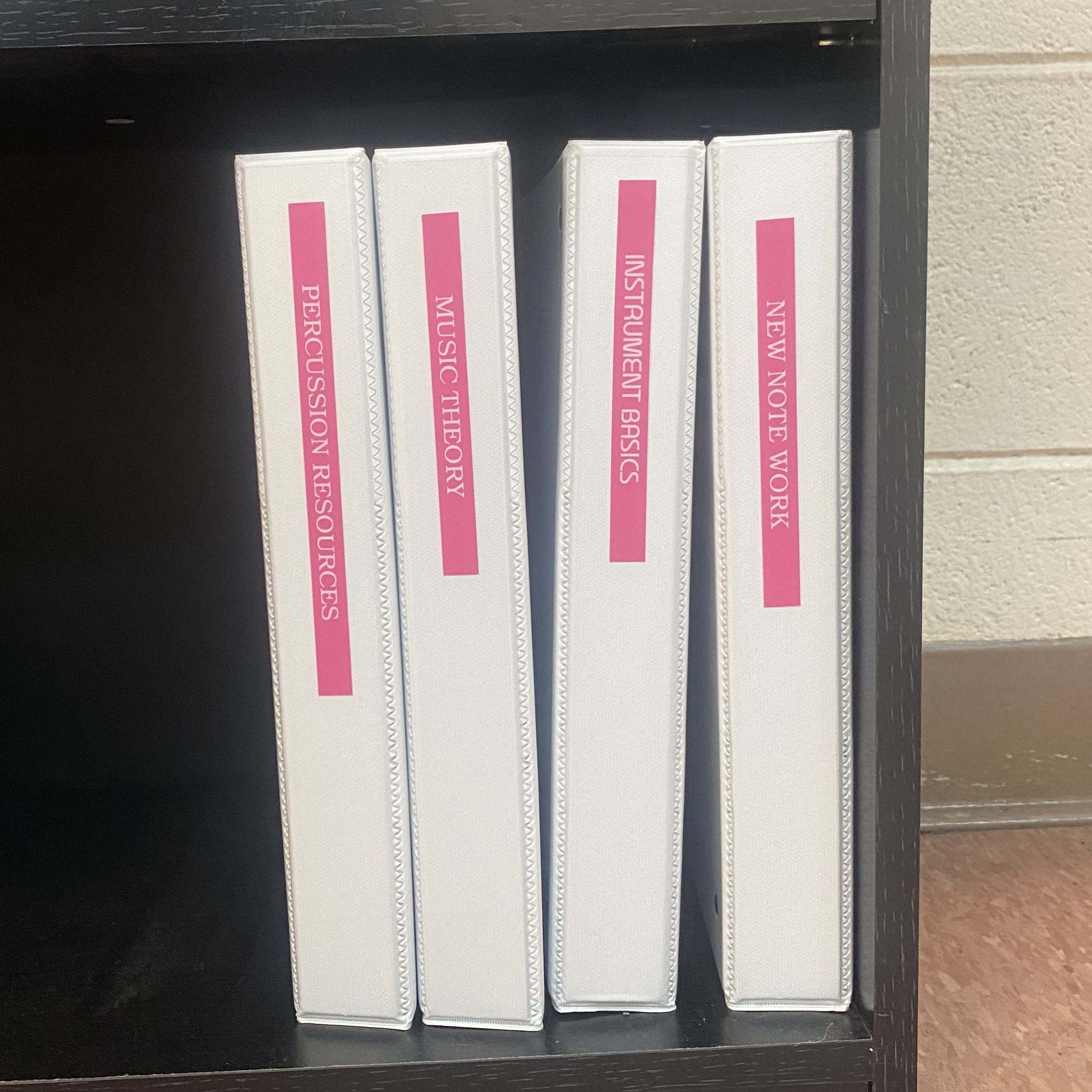
The binders that I keep for band and choir are organized in a few different ways. I have a binder called instrument basics where I keep master copies of the handout that feature care and assembly information for each instrument. I also have embouchure formation and major and minor scales for each instrument and rudiments for percussion.
Choir curriculum is mostly contained within the realm of music theory, so most of the handouts I use in choir are in the music theory binder. I keep pretests, midpoint quizzes, and summative tests in each tab as well as bell works, exit tickets, assignments, and guided notes. These will also get used by the band students, but I tend to follow the band book a little more closely and pull assignments from the music theory binders that will suit the band curriculum.

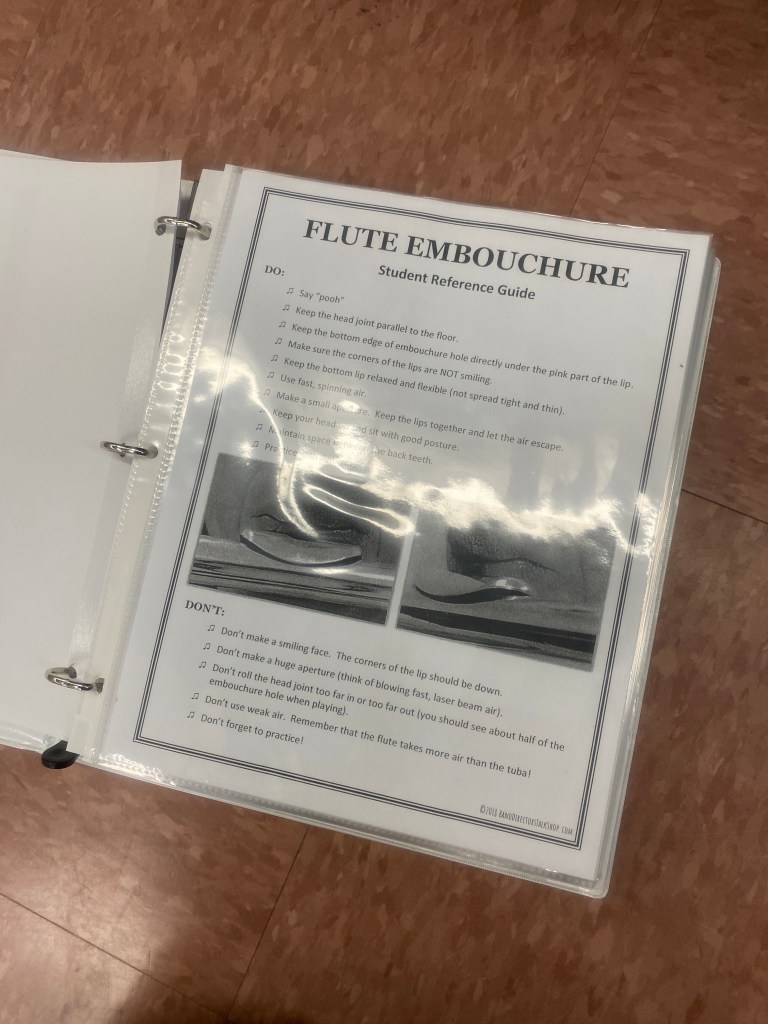
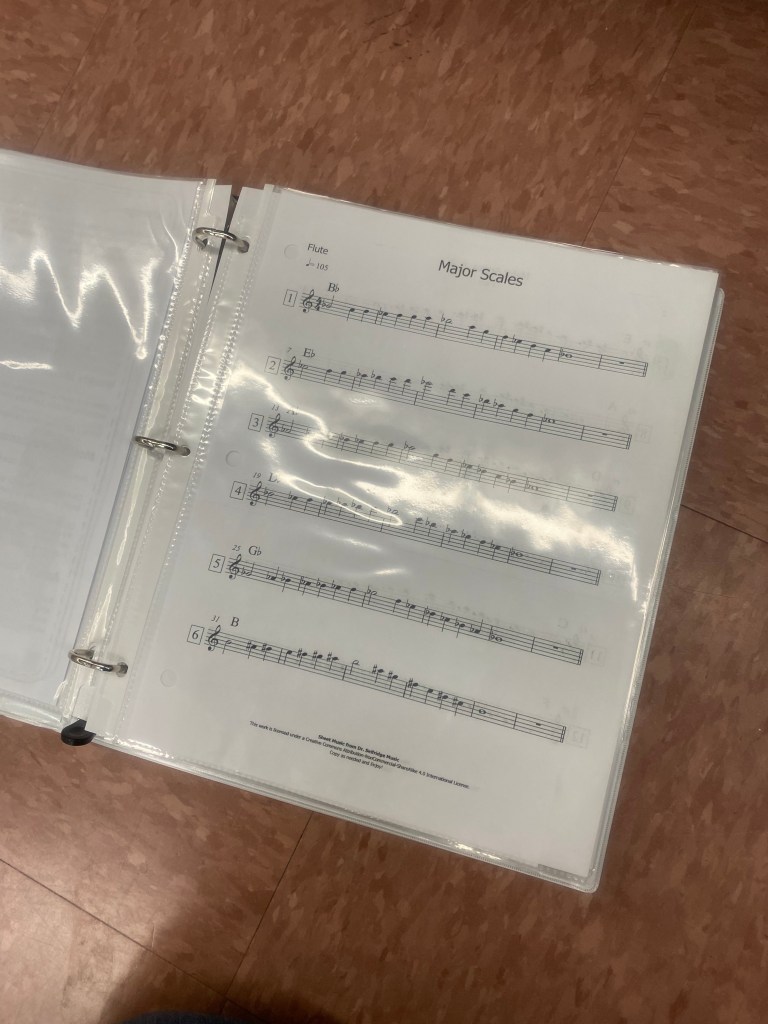
I also have a binder for things that are very specific to the band and the percussion sections. Again, these binders contain all tests and quizzes, notes, and assignments.
Ruler Boxes
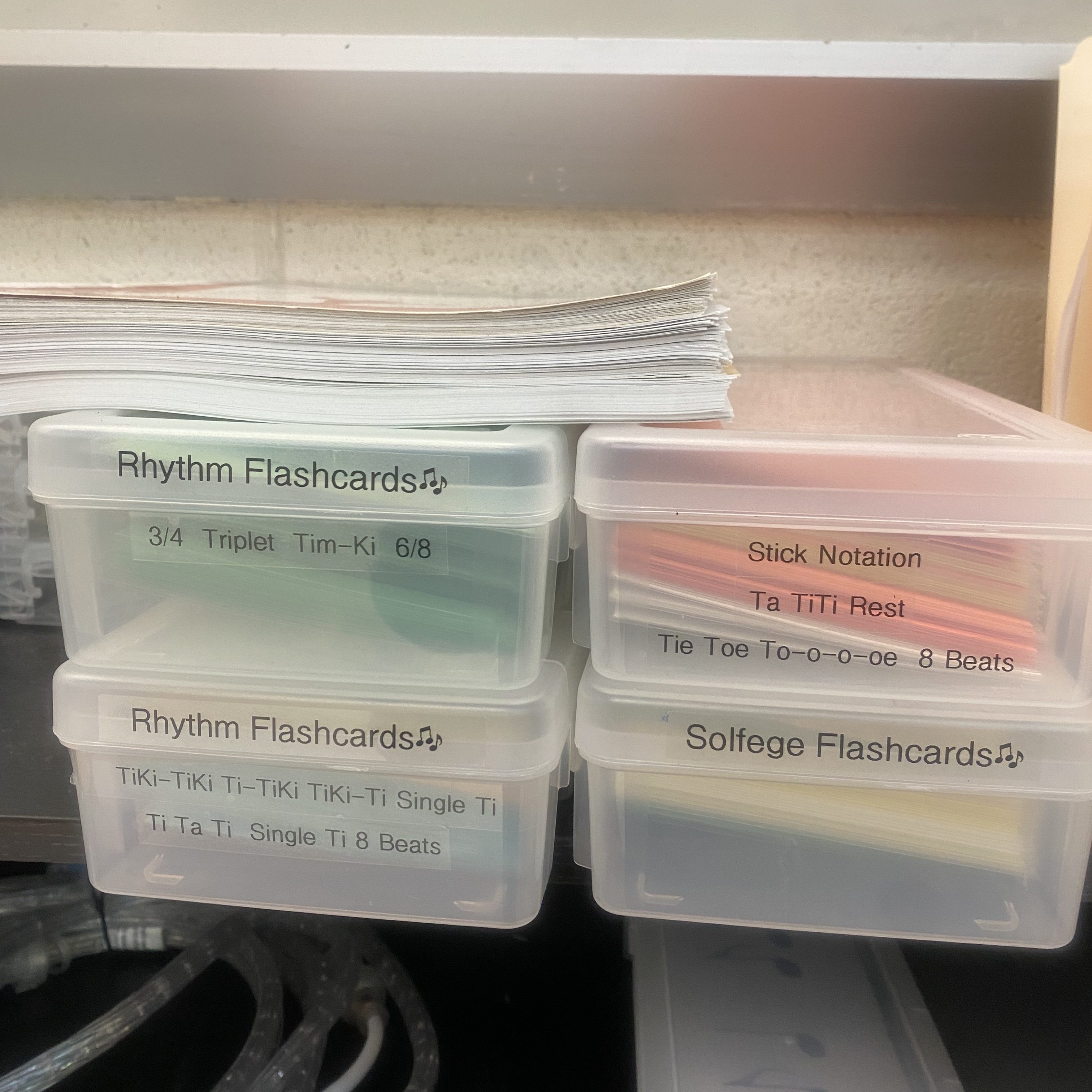
I LOVE these Iris Ruler boxes for flashcard storage. When I was initially job hunting I thought I would be traveling between two school buildings because I had applied to a few jobs where that was a requirement and one job was very interested in my application. Alas, I am thankful that I only have to coral my stuff in one room. However, I do teach all the things, so I have A LOT of music flashcards.
These boxes are the perfect dimension for half page music flashcards. I have all my flashcards laminated and separated by time signature or rhythmic content. I only have one box of solfege flashcards right now, but I have some ideas how I can make a set of flashcards that is more suited to the needs of my students.
I haven’t been able to find these in a physical store, but I you can find them here on Amazon. You might have some luck at Michael’s or another craft store, but I don’t live close to either.
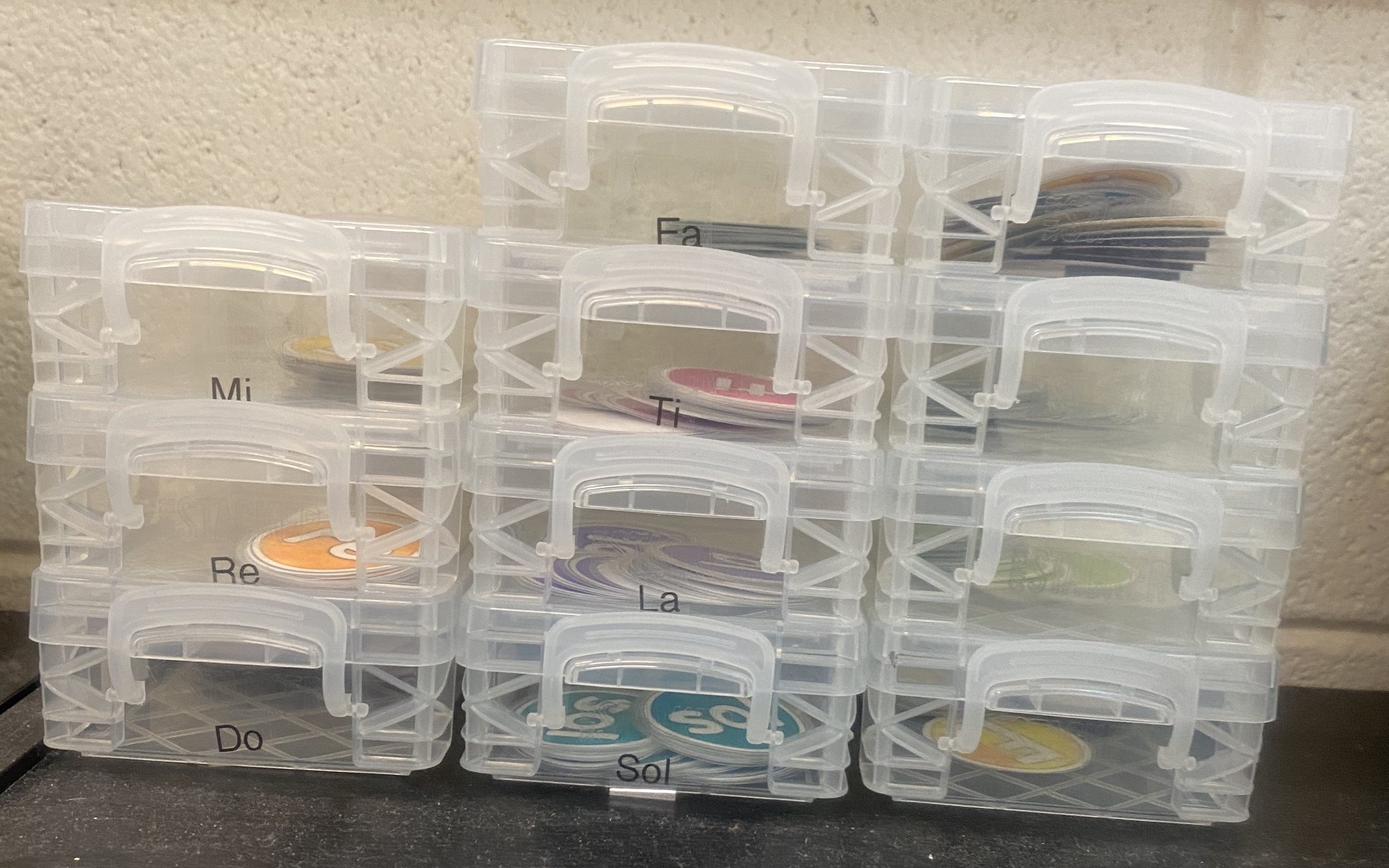
Crayon Boxes
I don’t actually have crayons in my classroom, but I do have things stored in crayon boxes. These little boxes were the perfect size for my solfege and notename dots that I bought from David Row. You can get these manipulative in his Tpt store here. If you have any other small manipulatives for then these would also be a great item to pick up!
Plastic Dressers
I literally walked around Walmart for ages with a set of mallets trying to find something that I could house all the mallets and drumsticks in for over an hour. I was hoping for something smaller or more compact, but I truly couldn’t beat these plastic dressers for mallet storage.
The wide ones are the best for anything that needs to be stored that’s a similar length to a drumstick or you could add a small section inside the drawer to store other items. I use the smaller dressers to store all the reeds my students will need for their instruments.
I don’t currently have pictures of this area of my room because it is a complete disaster. I keep all the reeds and stick behind my desk so that kids don’t and can’t just access them all willy nilly. But I do have these exact dressers that are linked here and here.
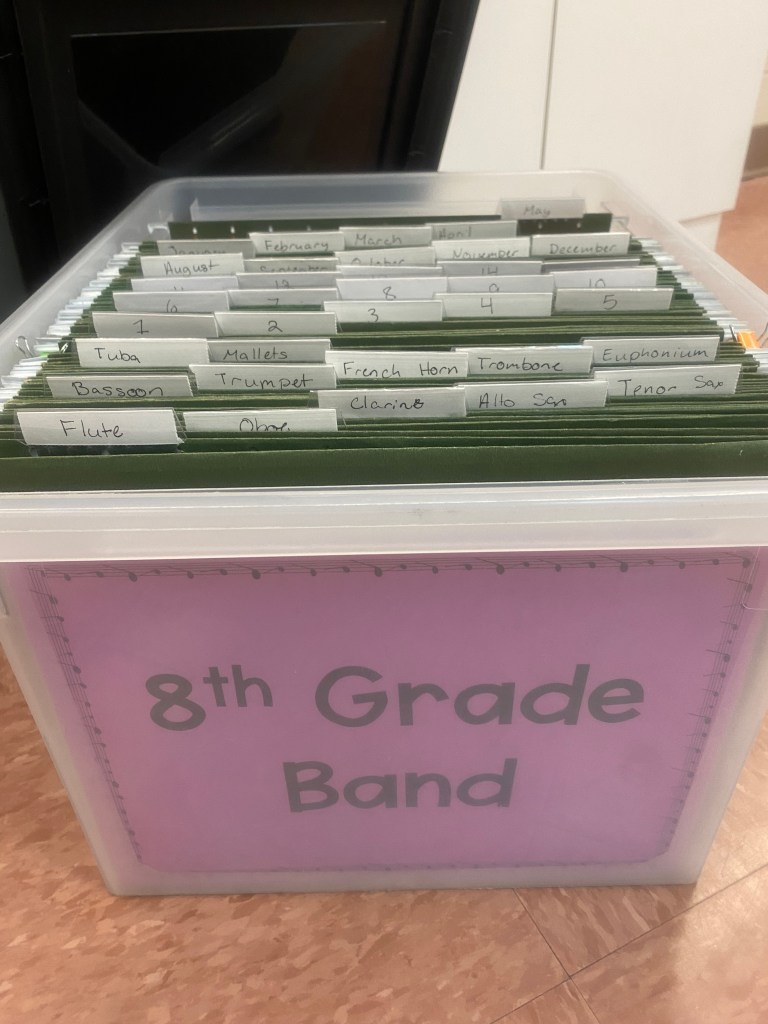
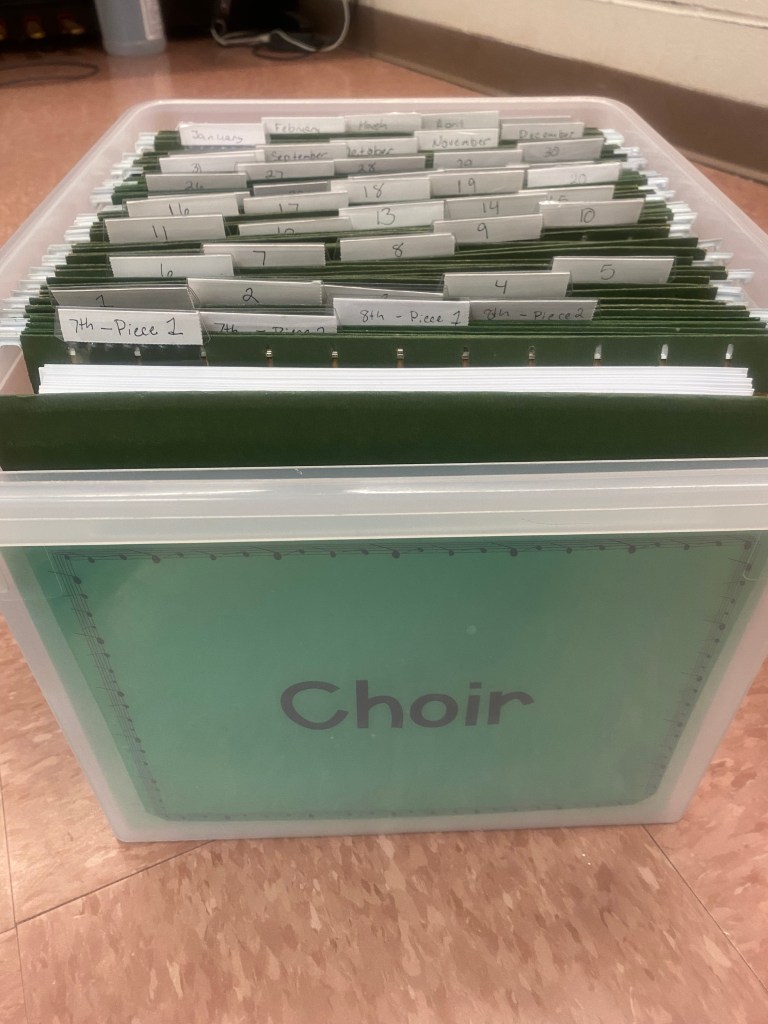
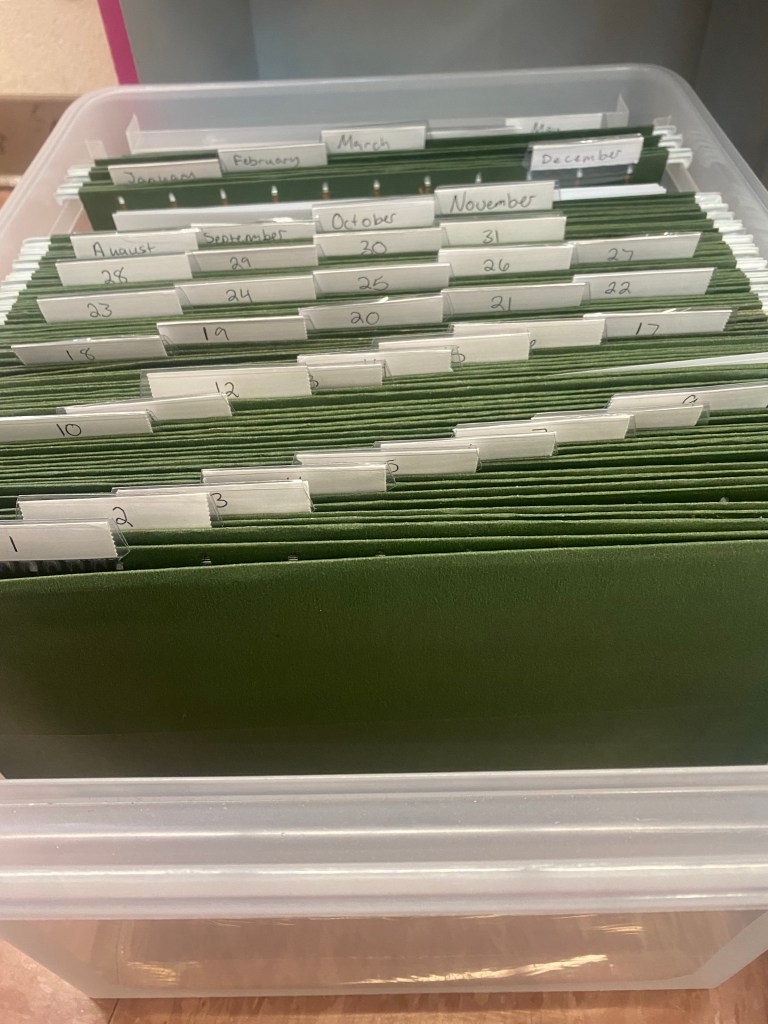
Hanging File Boxes
In my classroom I uses these awesome Sterilite hanging file boxes to keep extra copies of work around for absent students. I labeled hanging folders with numbers 1-31 for the days of the month and then I also labeled one folder with each month of the school year. With this system I am able to keep extra copies around for an entire month! At the end of the month I just place those copies in the folder of the previous month and we start fresh. In COVID times this has been very helpful, and it’s still helpful during cold and flu season. I wish I could say that this was an original idea, but I stole the idea to label the folders this way from Bridget Spackmen of the Lettered Classroom. She uses this idea to stay prepared well in advanced.
I keep one of these boxes for my general music class, and I have one for band and choir as well. The band and choir boxes have the same folders for the days of the month and the months of the year, but they also have folders for pieces that specific groups are performing. The band box also has separate folders for each instrument because I do have many instrument specific things that the kids need.
If one of my 7th grade choir students needs a copy of a piece we are performing they would look in one of the folders called “7th Grade Piece 1” or “7th Grade Piece 2.” 8th grade would do the same. If this same student was also missing on the 20th of the month they could check the box to see if there was an assignment given on the 20th.
A band kid that was absent could check on a specific date for any assignments, then check “8th Grade Band Piece 2” to see if a new piece was given, then also check the French Horn folder to see if the horn section was given anything instrument specific.
With enough coaching, you can get this system to become an automatic one that the students just check on to see if they’ve missed anything while they were out. Many of my students are still in the, “I noticed I have a bad grade. Am I missing any assignments?” boat. These boxes have helped me to pull their missing assignments SO. MUCH. FASTER!
-
Fun and Games with Rhythm Flash Cards
So you have a set of rhythm flashcards. When you teach students how to read rhythms you might start with the flashcards and chanting so that students only have to focus on one thing at a time. You only use your flashcards for group sightreading. The students are getting tired of flashcards, you’re getting tired of flashcards. What do you do?
Play games.
Rhythm flashcards can be used for so many fun games and can help liven up any performance based classroom. If you don’t know where to start with games and fun ideas for your rhythm flashcards, then you’re in the right place. Keep reading!
- Add Body Percussion
This assumes that you’ve taught students the four basic levels of body percussion, or have at least taught them a body percussion piece in the class beforehand. All you need to do is hand out copies of rhythm flashcards (I always have rhythms that I’m targeting for assessment) and give them your parameters.
By parameters I mean, do your students need to use the flashcards in a certain order? Do they need to put the flashcards in a certain form (AB, ABA, Rondo)? Are they only allowed to use two levels of body percussion or can they use all four? Do they even have to use the flashcards or are they allowed to compose from scratch as long as the rhythmic requirements are met? Lot’s of things to think about.
After Parameters have been set all you need to do is see if the kids are performing the rhythms correctly and with a steady beat. At the end of class it’s really fun to have the kids perform all of their compositions one right after the other to see how creative they were with all the same instructions.
- Have a Rhythm of the Day
Rhythm of the Day, Poison Pattern, Poison Rhythm, it’s all the same game! But the students still have so much fun and they want to win against the teacher. There’s nothing students love more than beating their teacher at a game, and there’s nothing I love more than the students getting specific, targeted practice on a rhythm.
To play all you have to do is take your set of flashcards and declare one is a Poison Rhythm. Have students perform and sight read this rhythm from the flashcard so that you know they can perform it. Once you’ve determined that they know how to perform the poison rhythm then announce that it is off limits. From this point forward, if students perform the poison rhythm when it is presented you get a point. If they see the poison rhythm and do not perform it, they get a point. The first to three wins.
- Compose with Flashcards
Getting students to compose music is a huge part of the national music standards, but I think it’s probably one that we forget to work on a lot. Flashcards can help us scaffold composition with our beginner musicians because they give the kids a nice comfy box. The box can be expanded later, but in the beginning they need a small box.
Assign several flashcards with familiar rhythms and see what students can do. This can lead to discussions about what types of rhythms made us feel like our compositions were complete and which rhythms made us feel like we needed to keep going. When you teach students about form, you can have them create a piece with multiple sections and discuss how they think each section complemented the other. I love composing with flashcards because it can lead to so many reflection opportunities and it provides the students with lots of choice and voice.
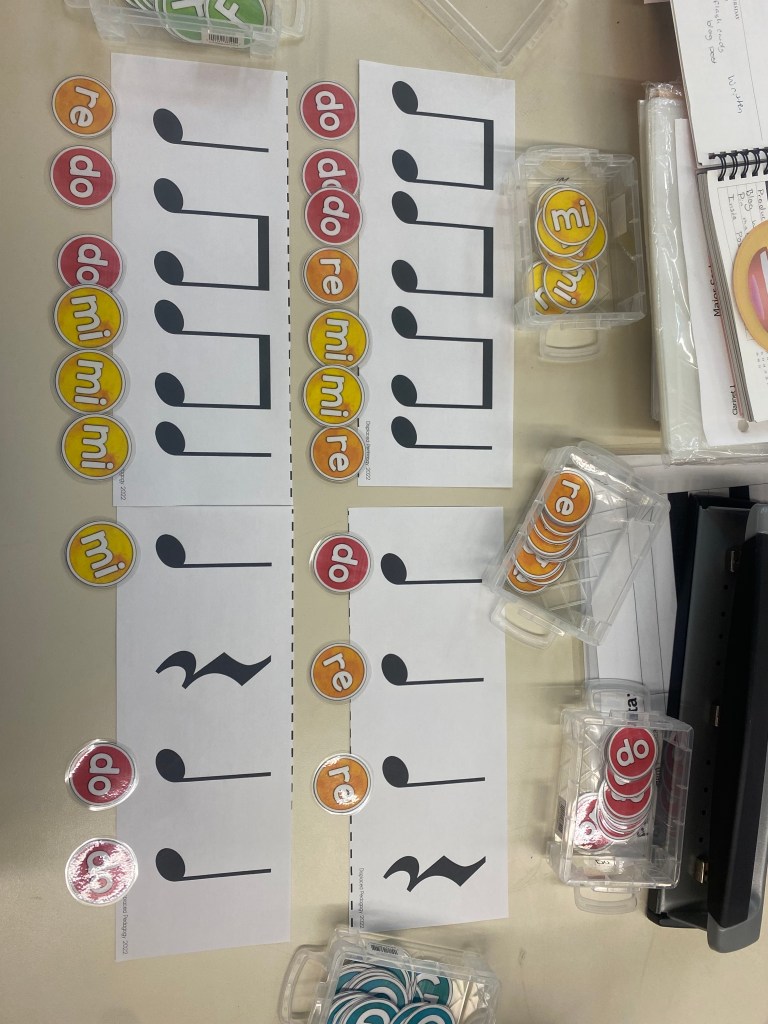
Rhythm flashcards with solfege dots underneath them. This is to represent one way that a student could compose a melody using rhythm flashcards. - Add a Melody
Similar to adding body percussion, adding a melody can be a great way to use rhythm flashcards. When we do this I start with a predetermined rhythm that I don’t let students change and a pitch set that I want them to focus on. This is also a sneaky way to get your band kids to practice specific notes.
Once again, you need to set specific parameters for the compositions. And when adding the melody I would highly encourage not letting them have a say in rhythm as each new note has a specific role that it plays in the scale. But they still get lots of practice on the rhythms because they’ll have to make adjustments to the melody a few times.
As you can see in the picture above I used solfege dots (I got these from Make Moments Matter on Tpt) to denote what solfege I wanted the melody to follow. They are super handy and can be found here!
- Play Four Corners
I love the game Four Corners! My students love it too. They love anything where they get to move around the classroom and not sit down for a few minutes. To set up four corners I place a card in each corner of the room that’s labeled A, B, C, or D. On the screen in my room I have a powerpoint with the rhythms and answer choices. I pick one of the rhythms to perform for the students, then they have to decode the rhythm in their head and move to that corner of the room. If they are correct then they get a point and get to brag to their friends. This continues until all slides have been gone through.
- Quiz Quiz Trade
Quiz Quiz Trade is a Kagan Cooperative Learning game. I am required to use Kagan strategies in my classroom, so I’ve had to finagle and work with them a lot to make it something that middle schoolers would actually use.
The first step is to distribute flashcards to each student. Students will stand up and find a partner. Once they find a partner, student A will quiz student B on their flashcard. Student A will either praise Student B for providing the correct answer, or will coach student B to the correct answer. Once this process has been completed student B will quiz student A and the whole process repeats. After both students have been quizzed, they will trade flashcards and find a new partner.
With this one you do need to watch and make sure that students are actually finding new partners and not just moving around the room with their one partner. I also add that students must check in with me for Quiz Quiz Trade one time, so that I can assess them.
- Headbands
Headbands is a classic game where one person wears a rhythm on their head and the other people help that person guess what is on their forehead. In the beginning of the year I will have students perform the rhythms on the headband and I will guess what rhythm is on the flashcard. This lets me know if my ensemble can perform all together and accurately. As students get more advanced, then they can start being the person wearing a headband. This really works the ear training and decoding skills!
- Gallery Walks
Anything that gets students out of their seats is a favorite of my kids. They love walking around and getting to actually talk to their classmates while we are in class. I use gallery walks every few weeks to help them scratch this itch and collect something to grade and use for interventions.
To set up a gallery walk all you have to do is tape a flashcard to the walls of your room. I would recommend at least 6 and no more than about 12-15. Students will walk around with a piece of paper that they numbered or an accountability sheet that you made and they will record their responses for each flashcard.
I will stipulate, make sure that you know where each number is so that you can help students if a flashcard falls off the wall. Make a key for yourself so that you can grade them easily. If you don’t want to make your own gallery walk I am working on making gallery walks for all levels of rhythms. You can get these from my Tpt shop!

A rhythm flashcard with quarter notes and a quarter rest taped to a cinder block wall. There is a number 2 drawn on it to show how one music teacher uses rhythm flashcards to make very easy gallery walks for her students. 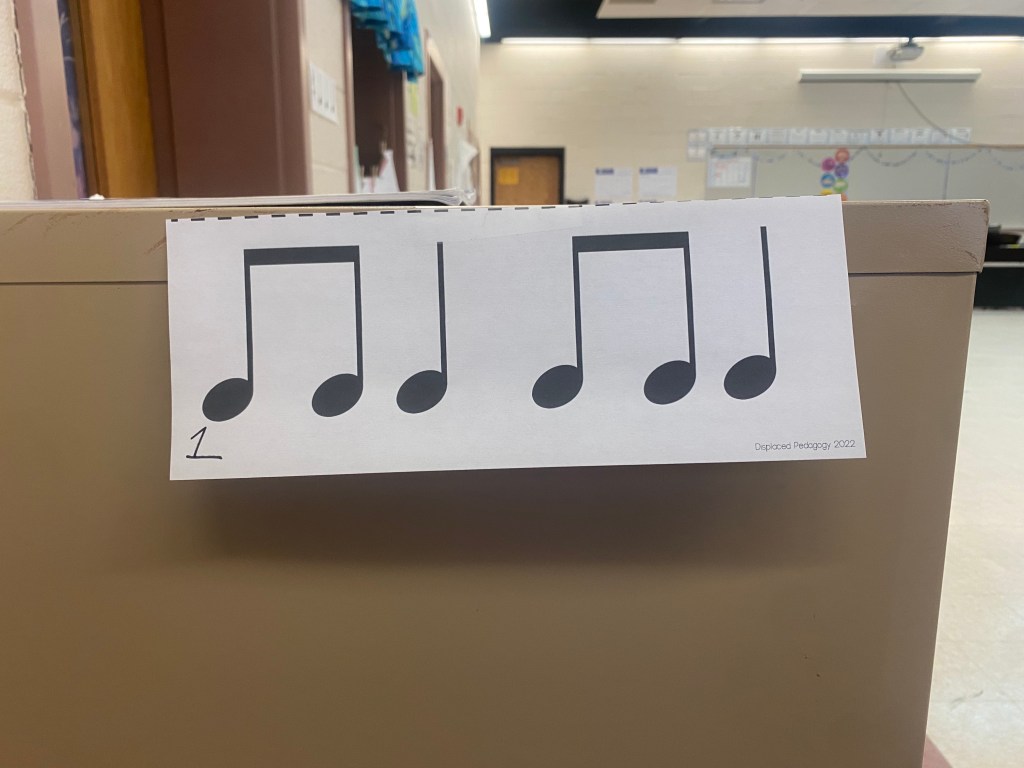
A rhythm flashcard with quarter notes and eighth notes taped to a cinder block wall. There is a number 1 drawn on it to show how one music teacher uses rhythm flashcards to make very easy gallery walks for her students.
You can also visit my Tpt shop to get FREE rhythm flashcards. All of my common time rhythm flashcards will be free! I am working on getting these uploaded as quickly as possible and I am working on making sure that they can be used for beginners all the way to advanced groups. -
Long Term Planning for Performing Ensembles

Why should I try long term planning?
If you’re reading this then I bet that you’ve heard of long term planning and want to know more. That was me a few months ago and I came to the conclusion that no matter what I needed a long term plan for each of my classes for the next school year. I teach middle school band, choir, and music history at my school. I knew my first year of teaching performing ensembles at this school that my students would have a very minimal, if any knowledge of music. I’m talking basic stuff like quarter and eighth notes, instrument names, treble clef note names. I wasn’t hoping for much, but I was hoping. They surprised me and seemed to remember a fair bit, so I was ecstatic.
That being said, in my district we are expected to submit lesson plans every week. Teaching three different subjects I had to write 15 lesson plans a week! I’ll be honest, I mostly just made up stuff that sounded good and then did whatever because none of the lessons made sense. I knew what to teach, and in which order, and I knew how I wanted to teach it. However, when it came time to put the plans onto paper, I just could never find the time.
This led to me planning concerts, but then doing most of the work at the last minute. I spent many days hoping that the kids had learned anything in class. And I was basically just surviving. I knew that something had to change before I went into the 22-23 school year. So this blog will describe reasons why I am sold on long term planning and the next blog post will break down how I made my long term plans.
What is long term planning?
Long term planning is basically a way to see all the things you need to cover in a year up close at all times. My goal for beginning band is to make it to page 40 of the beginning band book and be confident with those concepts. So in my long term plans I blocked out concert dates, the dates I would have to do instrument try out, any testing windows that I knew about or could guess on, and then I plugged in the sequence of note learning and so on a so forth.
Long term planning is a handy tool to see where you are, see where you’re going, and see what steps need to be taken to get to the goal.
Why is Long Term Planning important?
- I Needed to be able to see most of the year in one go
If you’re like me then you’re a very visual person and you are a busy person. I wanted to be able to see every single thing that I will teach in a year along with all the other things that I reeeeally hope I get to teach throughout the year. In my current year-long plan I have dates, rhythms being taught, notes being taught, expressive and mechanical topics, composers, and musical cultures that I would like to teach. I only use this document to list topics on a general date in the school year.
My old year long plan from last year is based off of a template from my school district and it just didn’t suit my needs. In that document we were asked to list our topics, standards, and vocabulary terms. This is fine, but since I have so many things that overlap together it just seemed impossible to fit a band or choir curriculum into that template. This template works fine for music history and I probably won’t be changing it much, but I needed a significant overhaul for band and choir.
- When you feel terrible, the plan helps you un-cluster yourself
I’ll be honest, we took too many rest days because I just felt so anxious about
deadlines and other things that I couldn’t even begin to focus on trying to teach my students. We had many cleaning days… However, during testing season I experienced that if you plan in advance (better than I had been) that it’s still really easy to teach even if you don’t feel wonderful and ready to go that day. So I’m developing the long term plan for next school year in hopes that I can get over the “I feel really terrible today” funk.
- It’s a lot of work upfront, but It’ll help you make daily plans faster
Once again, I have to plan for band, choir, and music history. That’s three different classes and three different curriculums I teach everyday. I very quickly this school year fell in the ocean of lesson plans. I was able to keep my head above water this year with music history because I could still get something useful out of the pacing guide that I made in the beginning of the school year.
- You’ll have a better idea of what to put in your pre and post assessments
This past year I relied on quizzes after each subtopic to help me figure out what students understood and what they needed more help with. This isn’t a bad thing at all, but it meant that there were more days spent test taking than were probably necessary. I want to spend more time actually teaching my students next year and I want to do more formative and less summative assessments. I also want to have my students be able to look at their growth from the pretest to the post test and be able to see actual growth, not the “our teacher had to take a few questions off the test and add two or three more because she lost sight of what she was doing half way through” growth.
I know which notes, rhythms, vocabulary, symbols, and “extras” to include on my pre and post test in the next school year. Knowing what I want to assess via a paper and pencil test I can also determine a suitable playing test for my students so that they can demonstrate the skills in multiple formats.
In Summary,
I hope I’ve been able to convince you to try a long term plan for your ensemble class next school year. I am excited to try it and have been eagerly planning my first unit already. (My inservice days are going to be really easy next school year!) If you’re interested then come back next week and see how I actually make the long term plan! I’ve already completed both plans for the bands next year, so you’ll get to see the long term plan for the choirs being constructed.
-
What I Wish I Had as a First Year Teacher
Getting your first teaching job is so exciting! If you’re anything like me you had 1,001 thoughts running in your head about all the things you needed and you didn’t know where to start.
Pause, take a breath and breathe deeply. If you’ve finished a degree program then there really isn’t a whole lot that you NEED. I’m assuming at this time that you’re reading because you are teaching middle school band, choir, or general music. I am teaching elementary music now, but I have not started creating content for elementary music teachers.
If you are teaching middle school band, choir, or general then you truly do not need a ton. Your school will already have school owned instruments and the like. You might have a set of risers (I had to purchase mine). General music peeps, you could have instruments or you could have nothing. I had nothing. I promise I’m trying to get resources out to you.
Here is the very short list of things that you NEED as a first year middle school music teacher.
Office Supplies
You only need the bare bones things to truly get started. Please do not go crazy at Target and buy tons of stuff you don’t need. In fact, this list is probably at your house right now. Really quickly, all the general office supplies you need.
Planner
Scissors
Tape
Pens
Sticky notes
A notebook
Some extra nice things you may want
Rhythm flashcards
Solfege flashcards (if you teach with solfege)
Note Name flashcards
A baton (if that’s your style)
Truthfully you may want to wait on the general office supplies until you get into your classroom to see what the school will provide to you. At my first school there was just a closet of all kinds of basic office supplies and teacher things like whiteboard cleaner. The front office also had a cricut, poster maker, bulletin board paper, and borders. So seriously, you don’t need to buy a lot of that stuff right off the bat.
I would focus on the planner and the specific things you will need as a music teacher. You’ll have your entire career to build a collection of stuff.
A Good Mentor or Teacher Friend
I didn’t have a great teacher friend until years two and three. But having great teacher friends truly makes a world of difference. Please do not just hide in your room and isolate yourself. Teaching, especially teaching music, can be isolating enough. You do not need to add to that yourself.
Having a good teacher friend helps because they are with you in the trenches and probably have a lot of the same frustrations as you. I still talk to my teacher friends from my old school and I try to meet up with them once or twice a year. If I lived closer I would try for at least once a month, but I live about two hours away now.
My point is, you need someone who understands and who you can commiserate with. Make sure you don’t pick someone super negative, but maybe someone who is a bit real.
Quality Resources
I really struggled with this one my first year. All I had was a band method book and about one or two of each student book to go with it. But I hated this book series. I made it work until we got new books (thank god for ESSER funds).
My school also had a lot of requirements of us teachers in regard to bellwork, formative assessments, summative assessments and the like. So I had to make all of those because I couldn’t find what would make my school district happy.
I am currently working on getting all of those resources uploaded to Tpt so that you can have them too. I have pre-tests, post-tests, quizzes, playing test forms and anything else you might need. It’s just taking me a while to get it all uploaded because now I teach elementary music and I am trying to get my life together for my new job.
The list isn’t that long, so that’s good! Your room won’t be Pinterest perfect the first year and that’s ok. Focus on building relationships with the students and focus on bettering yourself each year.
-
Summer Break Plans for Teachers
I’m officially on summer break and I’ll be honest, I am relieved. As a music teacher, I have concerts to plan and parents to contact about ensembles and all the other end of the year craziness that is part of teaching to begin with.
I am also a crazy person and like to have big ideas planned out for the following year, so that I don’t have to do all the work in the next school year. This means that I plan out concert themes and start generating rep ideas. I find PD because district PD can be useless, and I also reflect on the school year and think of ways that I can improve things for myself or my students. I know, it’s a lot.
So this year I’ve decided on a few things that I am going to do this summer and as a form of accountability for myself, I plan on sharing a lot of that information here and on my instagram page (@displacedpedagogy).
To start, here are the professional goals.
Take Kodaly Level 1
I am taking Kodaly Level 1 because I feel very insecure about how I teach melodic concepts. I’m great at practicing those concepts with the students, but I need more ways to practice and present the concepts. Kodaly Level 1 also focuses on Kindergarten and first grade, so I’m excited to improve my K and 1 instruction.
Yes I did switch jobs and grade levels this past year. You can read what I think about elementary versus middle school in a future blog post that I will link here soon.
Organize Centers for Most Content/ Concepts
The reason that I want to create centers for content that I’m teaching is because at my old middle school I had to keep meticulous data on all the students about their musical knowledge. I got very good at doing this in middle school, but you can’t give a second grader unstructured time to just “practice” and hope they use it well.
I also realized at almost the end of the school year that I didn’t actually know how each individual student was doing. I had a good idea of what each class could do. So I plan on creating centers (stations) and making myself one of the stations so that I can quickly check on each individual student.
Make a Concept Map and Stick with It
I’m actually pretty good at making a concept map, and I want to take the time to make one for my students because now I have a good idea of where they are at musically. One of the other things that I want to include in this concept map is themes to use with each grade.
For example, maybe kindergarten is working on long and short sounds, but they’re also going to go on their pumpkin patch field trip soon (a real field trip they do every year). I want to do lots of pumpkin things to get them hyped about the pumpkin patch, to build those cross curricular connections, and to build relationships with them.
Not every grade will love themes like pumpkin patch, but I have a lot of sporty boys that really enjoy sports, so I’m going to try to create a sports themed unit to get some buy in from them.
Finalize Repertoire for Concerts
I’m ok with not fully accomplishing this goal. But I do like having this thought out in advance, so that I can fit those songs into the school year. Now that I teach elementary music, nothing has bothered me more than having to stop all the awesome things we were doing in music to prepare for a concert.
This may also be an unpopular opinion, but I don’t like putting on concerts. It’s so stressful! That being said, the art teacher at my school and I have come up with some crazy ambitious ideas to better incorporate the student artwork into the concerts. In years past student art work has simply been the backdrop for the concert, but she and I agree that the art work also needs to be front and center. So the more I can front load all these concerts, the better!
How am I going to accomplish all of this?
I’m glad you’ve asked. I am going to work on school related tasks for one hour each day (Kodaly being the exception) so that I can get the things done. This is just one hour minimum, I will allow myself to work more hours if I feel like it. For instance, I may decide to cut out centers while I watch TV on the couch or maybe I can create my own centers for student use.
My thought process is that one hour is long enough to get something accomplished, but not so long that I feel fatigued or feel like I’m not getting rest. Speaking of rest, next I’m going to share my personal goals for the summer.
Walk 8,000-10,000 Steps a Day
The reason that this is a goal is because it’s not too much more than I walk in a typical school day anyway. I have been on a health journey for a while and I think I just need a little extra push to take things to the next journey. The extra 2,000-4,000 steps per day shouldn’t feel like too much and should be pretty easy to get. There are two parks with 1 to 1.5 mile loops within a 20 minute drive of my house (there are very few sidewalks in my city). The plan is to wake up and go to one of these parks and get a nice long walk in before I can wake up too much. If I start exceeding this goal on most days before July first I will increase the amount of steps to keep challenging myself. But I want to focus on consistency first.
Have Meals Ready to Go In the Freezer
Back to school meal prepping can be a challenge because my energy levels are ZAPPED in the first few weeks of school. I am planning on making one or two additional full recipes each week so that I can have plenty of food during the back to school times when fast food is going to be super tempting.
This will also help with grocery shopping expenses during the school year because I’ll be able to shop from my freezer so often. So this is basically a win-win for myself.
Get Blog Posts Written and Scheduled
There is no definitive amount of blogs I want to have written and posted by the end of summer. My goal is to simply have two blog posts written and scheduled each week at minimum. I will allow myself to write a third blog, but I think two minimum will actually be enough blog posts written to have a blog going out each week until my school’s winter break. This also means I can chill out with all sorts of business type things during the school year (more chill time after school is the whole goal this summer).
The only blog and non-blog posts that will not be scheduled out are going to be Friday updates I deliver on all of these goals.
Play More Board Games
I’ve recently gotten really into board games again, which is unfortunate because they can be very expensive! One way I am combatting this is only buy games if they are on sale or second hand. I also check to see if the game has a solo player mode since I game by myself most of the time. My sister has also lovingly agreed to a board game day every month so that I’m not always gaming alone.
I just think that board games are a great way to relax and get my mind off of work. So many games have such great artwork and are so puzzly, but the goal is different every time unlike other puzzles like sudoku (no hate because I also love sudoku).
Read Three Books
My yearly goal was to read five books this year, which will be five times more books than I read last year. However, I have a problem with turning my brain off so that I can focus and comprehend what I’m reading. My goal here is to read 15 pages before I go to bed each night because I also recognize that I need to have a bedtime routine to help me sleep better.
That’s it for now! I have several business goals that aren’t about blogging, but product creation takes a long time, so I don’t want to stress myself out by promising tons of products. I’m focusing on a few different very large products and have a goal to get them all uploaded by the end of July. If you want updates and notifications about the new products when they are released you can follow me on Teachers Pay Teachers and click on the green star. You’ll see my newest products first when you open Tpt and an occasional note to sellers when I update a product or have other things to share with you all.
But I hope that my list of goals inspires you to make some of your own goals for the summer. You can go ahead and follow me on Instagram as well and get real time updates and tips! Happy summer break!
-
Summer Self Care for Teachers

That time of year is finally here! Yes, it’s summer!
Well, it is for me anyway. If it isn’t summer when you’re reading this then I hope it becomes summer break very soon for you.
Summer break can be a magical time. Teachers can finally take some much needed down time to relax and unwind fully. Us night owl teachers can finally stay up past 11 without regret in the morning and we can all sip our coffee before it changes temperature on us!
Summer is also a wonderful time of year for making sure that you are taken care of because you, teacher, have spent nine or ten months taking care of other peoples’ children this year. You’ve earned the right to focus on yourself.
So, since it is the beginning of summer break there’s plenty of time to focus on self care. There’s some debate about how many types or domains of self care that there are, but I enjoyed this list of eight types of self care from Rocky Vista Health Center. It feels like a very comprehensive list of self care types. If you want to learn more you can visit their blog post on the topic here. I’m going to stop blabbing and just give you lots of ideas for this in your personal life and your teaching life.
8 types of self care
- Physical
- Emotional
- Psychological
- Environmental
- Professional
- Social
- Spiritual
- Financial
Physical
- Take up a hobby to get you moving
- Create a simple exercise routine
- Focus on getting more steps in than you did the month before
- Set timers to take a ten minute walk every 1-2 hours
- Focus on drinking enough water
- Start taking a vitamin (immune support because kid germs, ‘nough said)
- Get in the habit of having veggies at every meal or at one more meal than you’re currently eating (have veggies at lunch and dinner instead of just dinner, for example)
- Get enough sleep each night (I’m remind myself of this one)
Emotional
- Journal your thoughts and feelings
- Spend time by yourself with no distractions
- Have a good cry (If you’re like me then you need to read a very sad book to do this)
- Go to a rage room and get the frustration out
- Set boundaries with certain people in your life, you know who
Psychological
- Learn something
- This can be a new recipe or taking a professional development course. You don’t have to learn new things about teaching unless you want to.
- Set some goals
- These can be big personal goals like learning a language or how to tango or you can set a goal to have all of your centers prepped for back to school
- Do a social media detox (comparison is the thief of joy, after all)
- Play some games or do some puzzles, they help keep your brain sharp
- One of my forms of self care is to play board games because I just enjoy them so much
Environmental
- Make a cleaning routine for your house and try to stick to it
- You can revamp your classroom jobs so that the room is tidier at the end of the day
- Try to workshop an organization system for all the papers you need to manage in your home and in your classroom (if you’re like me they are completely different systems)
- Make a decluttering schedule for your home and classroom
- Do some planning (personal or school) in a new location for a change in scenery
- Take a day trip or vacation to somewhere new

Professional
- Evaluate your work-life balance, are there areas where you can improve?
- Make a plan for better work life balance in the school year ahead by identifying what took up the majority of your time now. Did you spend all your time lesson planning? Sketch out big ideas now, so you can focus on nothing but details later. Was grading your biggest time suck? Figure out some strategies to make grading faster for yourself so you can get home earlier.
- Show kindness to a coworker
- You really want the secretaries and custodians to like you, just saying
- Network with people who teach the same grade or content as you
Social
- GO SEE YOUR FRIENDS AND FAMILY!!!
- Sorry for yelling, but if you’re like me all your best friends live at least an hour and a half away. Summer is when I see them the most because we are either taking music PD together or we decide to have sleepovers. But summer break is THE time to make sure to see your people. Try to get tired of their face.
- Create new connections with people from work
- This is a great time to hang out with your teacher bestie outside of the school. I went to bingo with a few teachers from my school and had my mind blown because of the competitive style bingo. If you haven’t tried it, you should.
- Call someone you haven’t seen in a while
- This is a great time to call a teacher friend that may have moved schools, or to call a teacher friend from your old school
Spiritual
- Meditate or pray
- Spend time in nature
- Spend time deciding your core values
- Spend some time manifesting
- Learn about astrology
Financial
- Set up sinking funds
- I highly recommend this because sinking funds for various things have helped me to not blow up my budget from month to month. All you do is figure out how much money you need to set aside in a period of time and put that money in a savings account.
For example, if I want to pay the six month premium on my car insurance to save a bit of money I would figure out how much to set aside over a given amount of time to do that. In my case, I set aside $100 each month for six months to pay the next six month’s car insurance.
- I highly recommend this because sinking funds for various things have helped me to not blow up my budget from month to month. All you do is figure out how much money you need to set aside in a period of time and put that money in a savings account.
- I also have sinking funds for professional development courses, conferences, and professional memberships, just in case my school district decides not to cover the expense or I can’t find scholarships to attend such things.
- Make a budget and stick to it as best you can
- Make sure to take into account things like vacations, event (birthday/ anniversary) expenses. Budget in starbucks if it’s that important to you. You’ll be bad at budgeting the first few months, but you’ll finally learn where all your money is going and will be able to tailor from there.
- Check in on your retirement accounts
- Set some financial goals
- Pay off debt
- Set up a High Yield Savings Account
- Just do it, you’ll thank me later. This is where I keep my sinking funds and emergency fund and last month I made almost $7 in interest with less than $3,000 in my account.

You can definitely tell which forms of self care I typically indulge in. I hope you find something beneficial from this list. My recommendation is to pick one or two things that you can do daily, like take a vitamin and drink water, and maybe one thing that will take time to develop, like budgeting.
I personally, enjoy the self care that benefits my future self the most, so those are just my recommendations. Have a great summer and get plenty of rest!
-
The Ultimate Recruitment and Retention Formula for Your Music Program
Every year it almost feels like a rat race to get a new wave of students interested in joining band, choir, or orchestra. It feels like all the stress is on impressing the young elementary students on your recruitment concert tour. Or maybe you’re a high school director and you’re stressed about making the pep music and the concert band music sound good to get those middle schoolers to become freshmen in your program.
But recruitment and retention are two sides of the same coin. You can’t recruit more kids into your program if you aren’t able to retain the ones you’ve already got. And this idea that I’m going to tell you isn’t original at all. I heard it from a collegiate choir director at KMEA last year.
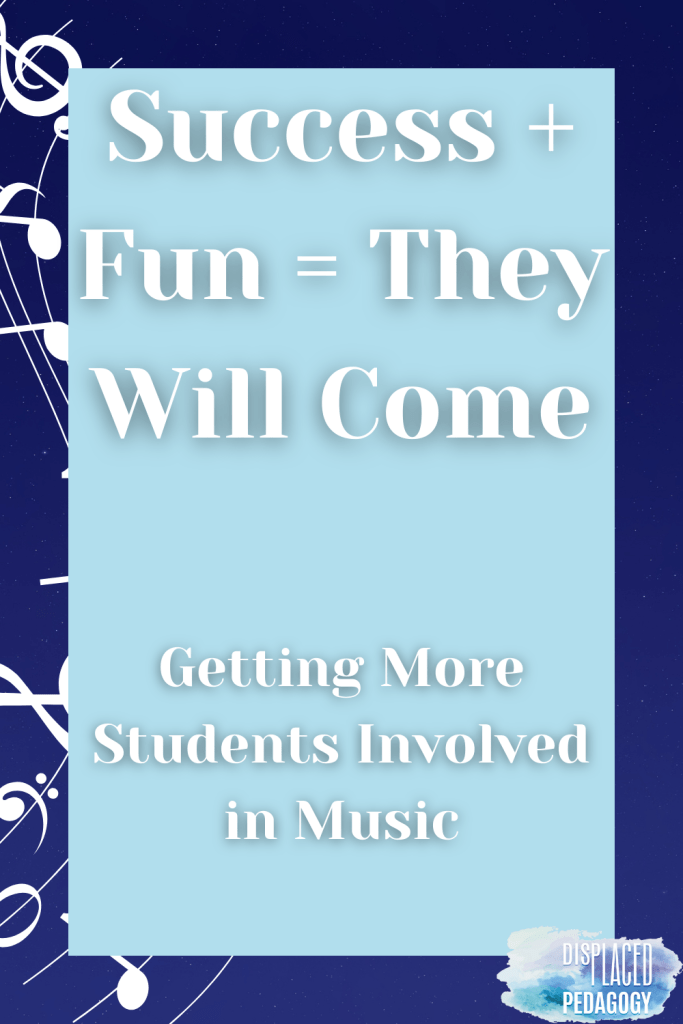
Success + Fun = They will come
Simply, this means that if you make your students feel successful regardless of the level that they’re at and if you make sure they have fun, then this won’t be hard at all!
Success
In order to build success in your students you need to make sure you choose appropriate and fun literature for your students. Please don’t program Lincolnshire Posy when your students are only capable of The Tempest. They will not feel successful, they will not have fun, and they will quit.
Students deserve to feel great about the concerts and performances that they give! This includes making sure that you’ve taught students more than the notes and rhythms. Beginners love flexing that they can play music that sounds sophisticated with the dynamics and the articulations. Don’t ignore these things with your beginners; they are capable.
Last year I was able to get my 8th grade band (half beginners and half second year, three IEP students) to play in three time signatures, six key signatures (some limited ranges for my newer members), and we were doing excellent with dynamic and tempo changes. If I had had another month of school we would have gotten all those subtle articulations as well.
Build in assessments to check on skills and brag about the students that do really well. Hang up student work that displays great effort or something to strive for. Post pictures of students that travel to auditions with you and even more pictures of students who made the audition at the event (the candids are the best). If you have students that compose music then make sure to play a piece of theirs on the concert or let everyone know that they placed in a student composition competition.
There is no wrong way to make students feel successful and this is half of the battle to get them to join and stay in your program. Let’s talk about the other half now.

Fun
This is everything from you just being nice and fun with the kids to making sure there are non-instrument days where the focus is having fun away from the instruments. Part of having fun in a performing ensemble is just performing fun music. If I were still at my old school we were going to play a piece called Santa the Barbarian and another piece called Carol of the Boombuckets on the christmas program. My 7th graders becoming 8th graders loved both pieces and were so excited to play them. I’m not sure what they did instead, but hopefully the new guy is having a blast with them.
Currently, I teach elementary music (I never got to finish blogging all things middle school, so I’m getting all these ideas fleshed out here). My students this year turned the story book “Snowmen at Night” into an entire production with musical performances and student-created creative movements and everything. The kids had a ton of fun and the parents and staff thought it was great.
My middle schoolers loved traveling to auditions and performance assessment because who doesn’t love missing school to make music instead. We had just begun fundraising for a music in the parks field trip before I resigned.
You can also gamify certain parts of your curriculum to help students buy into the class more. Don’t just assume that they love sitting in a chair in front of you and hearing you talk about half notes.
Also, students like to know that you’re a real person. I can’t tell you the amount of times I’ve just sat down and had lunch with some students. I had tons of students that always wanted to show me theri dresses or nails for the school dance and plenty of students also wanted to show me their suits. On reward days where we take a well deserved day of rest I would play card games with the students. So much of the students having fun is them enjoying who you are as a person.
I’ll say this again here, if students feel successful in it they will have more fun without you having to ham it up.
So wrack your brain and try to think about how you make the students in your classes feel successful. What do you do to make class fun?
-
How to Generate Hype for your Program During Recruitment Season
‘Tis the season! Between spring concerts, adjudicated performances, graduation concerts and everything else, you may have forgotten about recruitment. Or maybe you haven’t forgotten about recruitment, but this is one of your first recruitment events that you’ve put on and you’re stressed out. I’ve got you! I’m still new to this rodeo, but I learned a lot from my first.
I’m fortunate enough that my recruitment concert is one time and all the incoming students come to us. My tips and advice are coming at you through that lens. If you have to travel to your feeder schools then you can still make some of this stuff happen, but it may look different. Take whatever ideas you can easily use and leave the ones that don’t make sense for your situation. But if you keep reading I’m sharing five ways to generate hype for you music program during recruitment season!
Put Together a Recruitment Concert of Pieces for your Target Audience
Last year for our recruitment concert I talked to the incoming 7th graders about what band was like from day to day. I explained that we would sound kind of bad on the first day of instrument playing, then I let my students recreate that sound.
Not only did my students enjoy getting to make absolutely horrible sounds on their instruments for a few seconds, but then my students sounded a lot more impressive when we played our pieces for the incoming 7th graders.
My plan for this year is to do the same thing. Then have my students play Hot Cross Buns and Twinkle Twinkle Little Star. Those are just some of their favorites from the book and the incoming 7th graders should know those pieces too. Then I plan on telling the incoming students that after a while we graduate to “big kid” pieces and we will play “Ancient Hunters,” which is one of our assessment pieces.
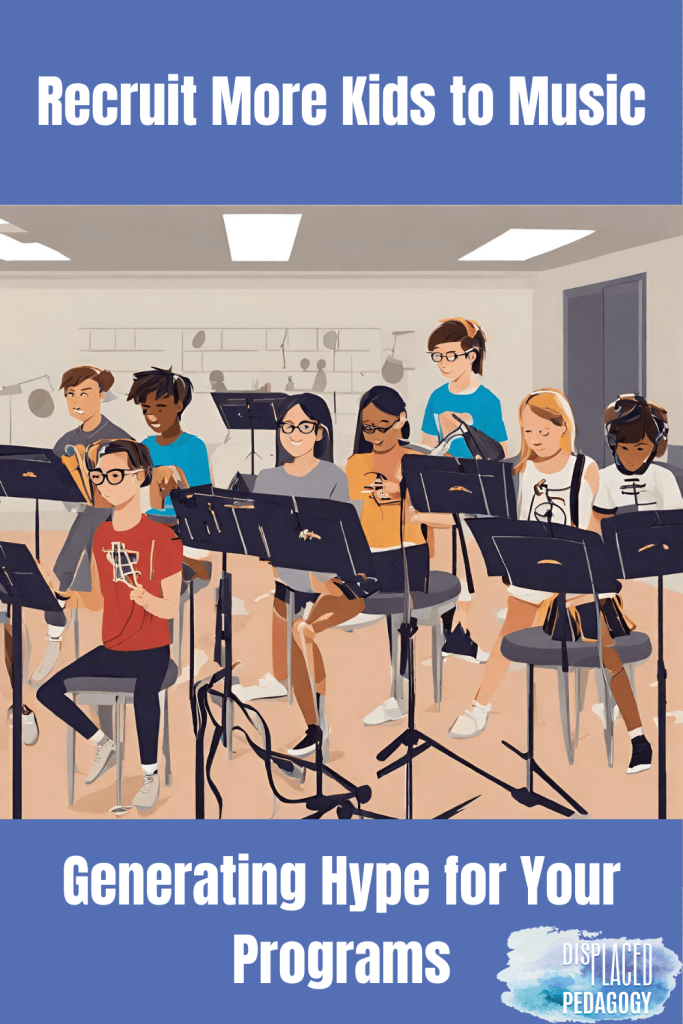
For choir recruitment, I really want to emphasize that we play a lot of games to help the students learn. But I may save that for when the students are doing tours of our classrooms. My plan for the choral portion of the recruitment concert is to take the kids through a timeline of what we do in a year, similar to how we are doing that for band.
What this means is that I will have the students sing some of our favorites form the beginning of the year (all unison pieces). Then I’ll have students sing our favorite rounds. Then we will add vocal ostinatos to those rounds and we will culminate with the last chunk of “Cherry Blossoms,” another assessment piece form this year.
Try to Make the Concert Interactive
I have not yet become a master at this; however, there is a really great band director in my state that always brings little kids down to the floor or up to the stage and he has them conduct the band with him.
It’s so cute! He talks about how he has the power to control the band because of his baton and makes a huge deal out of, then he invites them down. He gives each student something to hold while they conduct (think fancy straws or pencils). He and the young kids will conduct together for a while, then he just takes off and lets the little kids keep conducting the band. He only comes back to conduct the end of the piece and help the band end together.
I imagine that you could do this with choir as well. I just haven’t seen that happen. I have seen conductors do the choral warmup where every section sings part of a chord and then the conductor will tell each section to raise or lower their pitch by a half step. I think that could be very engaging for a whole audience.
If you use the S-Cubed sight singing curriculum, like I do then I might play a round of forbidden pattern with the audience. I personally would swap out melodic content with rhythm content, but that’s because of the area I teach in. This would also be a great way for incoming students to see a bit of your classroom if they stop buy for the tour after you’ve covered that part.

Showcase the Positive Things about Your Program
By the time that our recruitment concert happens all of my performance assessment will have happened for the school year. One of the things that I plan on doing for our recruitment concert is pulling out every performance assessment certificate that my program has earned and displaying them on a table. Since we haven’t done anything where you can earn a trophy, this is our closest thing.
The recruitment concert is close to the award banquet that I’ll be having at the end of this school year. So whatever prizes (think pins, trophies, plaques, medals, certificates) that my current students have earned will be on display, but my current students won’t know that they’ve earned these awards yet.
I’m also going to place all the news articles that I’ve written about the band and choirs this school year on the bulletin board where I showcase excellent student work. This is a way for students and parents to see that your students are out here doing the work to become very excellent musicians and are being rewarded for their efforts. Students like to see that they will be rewarded for working really hard!
In my classroom we do progress monitoring through badges and sticker charts (it depends on the class). Those are on full display in my classroom and will be explained in a bit more depth when the incoming students come into my room. these are very visual, eye catching ways for my current students to see that they are making progress and should be proud of themselves. I’m hoping that it is also something that incoming students decide that they want to be a part of.
Let Kids Know that they don’t have to choose between sports or music
If you also teach in a really small school district then you probably run into this problem frequently like I do. I have anywhere from 8-15 students each year that come up to me and say that they wanted to join band or choir, but they were afraid that it would interfere with sports.
To remedy this, I have been asking my students for their sports photos and action shots of them participating in sports. So far, I only have a few pictures. But I know that I will get more pictures with more reminders. my ultimate goal with this is to explicitly say that I only ask for two after school commitments all year (the rest of the performances are during the school day). None of my students have ever had to miss a game because of a concert, none of my students have ever been penalized for missing a practice due to a concert either.
I hope that bringing this up and having pictures of my students doing both and being successful at both will help curb some of that and I’ll hopefully have fewer 8th grade beginners as a result.
Have Your Current Students talk about the Program
Your students are your biggest advocates! Your music parents are also your biggest advocates! You should try letting them talk about all the wonderful things that go on in your program and classroom.
I am going to have my students complete a Google Form and tell me what things they like about the music program at my school this year. This will allow my more introverted or shy students to have their voice heard. With their permission you can also put their quotes into a presentation and have it play in the background while you’re performing for the incoming students.
You could also have current students talk about the program while you are transitioning in between pieces or performing groups. Let the student (or even small group of students) talk about a fun memory that they had in the music class, or on a trip, or anything that makes it sound like band, or choir, or orchestra is the place to be!
I hope that you’ve found something helpful during this blog post!
-
Write the Room for Music Classes
This activity was all over the internet last school year. Elementary music teachers especially latched on tho the write the room activity because it gets students up and moving and they get to work collaboratively and independently as they please. After COVID this type of activity feels like a breath of fresh air in comparison to the regimented “stay six feet away from everyone at all time and sharing is NOT caring anymore.”
Don’t get me wrong, I don’t want anyone to get sick. Seeing hundreds of kids and teaching them how to breath well had me cleaning everything! So write the room activities were finally allowed again and it felt awesome and like a wonderful return to normal after enduring the pandemic for so long.
What is a write the room activity?
A write the room activity is, at its simplest, where you place a bunch of flashcards, task cards, or something else all around your classroom. Students will take their recording sheet and a clipboard all around the classroom and record their answers for each question. This is supposed to be an easy way for you to asses things like vocabulary or basic reading skills.
Is write the room a valuable learning experience?
With all the undeniable research that says students learn better with movement throughout their day I would argue that this is valuable for the movement aspect and the novelty of the activity. We spend so much of our day telling students to hush and sit still, so this lets them move around and talk to each other for a few minutes and I think it just helps make the classroom less stressful, in addition to being a novel way of having students demonstrate learning.
This isn’t a worksheet where students have all the questions right in front of them and they write the answer. This is an activity where they only have the number of questions in front of them and they have to go find the questions and figure out the answer.
How do I set up a write the room activity?
All you need to do is post questions around the room.
I’ve done this by writing questions in sharpie and telling students to number their papers one through whatever. I’ve made a themed thing (they liked the aesthetic). I have also drawn numbers on and then taped my music flashcards around the classroom. There are so many ways to physically make a write the room activity.
I’ll say it again, I’ve written out the questions with sharpie and taped the paper to my wall for these activities. But now I also have several different Write the Room activities available on my Tpt store, you can check it out if you like.
What can I use this activity with?
I think the better question is what can’t be used in a write the room activity. I have used rhythms, note naming, solfege (I’ve taught choir too, just have more band knowledge), music theory concepts. I’ve seen where teachers have used story prompts to help students with creative writing (this might be an interesting way to get students composing). For middle school general music I will sometimes use a short reading passage and a few pictures to help introduce or reinforce a new topic in music history.
If you’re feeling that you need to shale things up a tiny bit in your classroom or want to combat the second semester blahs you need to give the write the room activity a try!
-
How to Drill Fingerings in Beginning Band
Teaching our beginners new notes is so important, but also so challenging. If they’re brand new then they might still be learning to read a fingering chart and maybe they’re still learning which colored in circles mean which finger get pressed down. It’s hard. So keep reading and I’m going to tell you my no frills tips for making sure students know their notes and fingerings.
Focus on the New Note for a Long Time
When I introduce a new note we focus on just getting the fingering correct for a very long time. I’ll have students hold up their instruments so I can scan the room and check for correctness and I’ll also walk around the room to check slide lengths and make sure the percussionists aren’t just guessing.
Then I have students play the new note while either reading rhythm flashcards or echoing rhythms that I am performing. We will spend a lot of time on just this new note and practice making it more automatic. It is tedious, but they don’t struggle with this for longer than a day or two because we are focusing on making the neural pathways in the brain.
I’ll also specifically tell students to take their fingers off the instrument or to take a talk break or something to distract them so that they have to place their fingers in the correct place again. This helps build a lot of muscle memory without putting it into musical context yet.
Put the New Note In Context
This is where you start having students practice playing short musical examples to practice their new note with familiar notes. In any musical examples you choose you should only use familiar notes and rhythms except for your new note.
There are tons of ways to do this and I take this step before I let students play the new note drills in the method book. I find that many of those drills add too many notes all at once and are just a bit too complicated for students who already struggle to read.
In order to set students up for success I create examples with simple rhythms that add one note at a time until students have four or five notes surrounding the new note and can play most known rhythms in the same excerpt. Again, this is a slow process, but their learning is so deep once we get through the process.
Make Assignments About the New Note
I was required at my old school to have bellwork for students everyday and I needed to put one of the bell work assignments in as a grade everyday. Because of this, I created a set of bell work to help my students engage with the new material in different ways and to make sure I had some grades in for admin.
This bell work is a half sheet only and students are asked to write in the new note on the staff, identify the note when given choices, and to fill in a blank fingering chart diagram with the fingering of the brand new note.
If you are interested in this bell work and want to check it out more then you can look at it in my Tpt shop here.
Have Students Perform the New Note Often
This tip literally can’t be done without tip one and two, but I’m going to say it again: Repetition, especially correct repetition, is the key to mastering the basic skills you are teaching your students.
Gamify
So far I’ve only told you really “boring” things to do to help your students learn new notes. Gamifying your instruction helps to add some fun and to help the kids “eat their veggies” when learning hard things. Don’t do it everyday or they will get bored and whine about playing games (and yes, this can happen. I have a few coworkers that use the games so often that kids complain when I decide to do it too).
I could go on forever and ever about how to gamify your instruction, but that’ll have to wait for a different post. For now I’m leaving links to GemKit, Blooket, collaborative sticker murals, and Class Craft.
You can also convert board games into learning games. I love using task cards in conjunction with Jenga (students have to answer the question correctly in order to have their turn). The sky’s the limit with gamification and if you want more ideas you can check out my Pinterest account for ideas and I have a few games in my Tpt store as well.
-
Advice for Beginning Ensemble Directors
There’s so much that you need to know as a beginning ensemble director and if you’re a brand new teacher it can also seem very overwhelming. I’m going to give you three tips that I wish I had learned faster as a new teacher and that have honestly helped me stay sane. These three tips are very broad, so adapt them however you need to, but I believe that they’re super helpful nonetheless.
Sweat the Small Stuff
Obviously, don’t dwell on the very first note for the first half of the school year, but do make a big deal out of the small things. Make a big deal out of embouchure and breathing, this will pay off in the tone quality of your students. Make a big deal about learning scales and scale chunks, this will help improve pattern recognition in music and make their sight reading better. Make a big deal out of routines, procedures and behavior expectations, you will eventually have less interruptions during rehearsals.
Develop Some Healthy Habits
If you aren’t healthy then you won’t feel good. If you don’t feel good then my next point will be near impossible to do. Start implementing healthy habits one after the other and soon you will feel like a whole new person. Last spring I started strength training two times a week and I started feeling like a whole new person. I was never able to stay consistent with three times a week because I was constantly on the move with school functions in the spring, but two times a week was enough for me to start noticing more energy, a better mood, and better sleep after about a month.
This fall I’ve started getting enough sleep finally. I start morning duty at 7:10 daily, and that lack of leeway has finally pushed me into getting enough sleep each night. At my old school it was easy to sleep in a few minutes (or an hour) here and there because I only had morning duty a few times a year. Now I am going to sleep anywhere between 9-10pm each night and am waking up anywhere from 5-5:30am. I’m writing this on Fall Break and today I woke up at 5:45 without an alarm set. I’ve noticed that I need a lot less coffee to start and stay going and I’m able to establish a stronger morning routine, so theres no more running around my house looking for my stuff before I leave the door.
Some other healthy habits to think about starting:
- Eating a vegetable at each meal
- Regular classroom decluttering
- Regular house decluttering
- Cleaning routines for your house or classroom
- Reading daily
- Take a vitamin
- Journaling
- Meditating
- Doing cardio
- Meal planning
The sky is the limit. My advice is to start with something that will help reduce your mental load (which we all have enough of as teachers). I started with meal planning and now I’m batch cooking and freezing for extra busy weeks. I’m trying out a weekly lesson planning routine right now so that I don’t have to think about it so much.
Stay Consistent
This is easier said than done. Especially if you don’t feel good at work one day. Staying consistent in your expectations can be difficult if you don’t feel your best, so that’s why it’s important to start developing healthy habits.
Staying consistent will also help kids get used to a routine and structure and therefore help with classroom management. If students know that every time one of them forgets their instrument for rehearsal that they will have to write a responsibility essay, then they will eventually stop forgetting instruments. If you are consistent in assigning bell work every day then students will just automatically start bell work when they come in.
This is where planning instruction well in advance is also helpful. If you aren’t planning instruction on a daily basis then you get to go through the motions if you feel sick on a particular day, which means more consistency for the students.
-
How to Organize Band Equipment

There’s a whole lot of stuff that goes into being a band director. And the problem with having a whole lot of stuff is knowing what to do with it! My old classroom didn’t have any built-in storage and was quite literally a big box with four crooked walls, so I had to get very creative when it came to storage. We didn’t have a PTO at my old school and there was money, but sometimes I would just run out and grab something because it could take forever to get the PTO, make the order and then actually get the item. Especially when it was so much faster to just go to Walmart or Amazon.

I am not sponsored, and these are not affiliate links. I just sincerely loved the solutions that these products offered to me when I was at my old school and I actually left all of it at my old school for the new person to use because I managed to increase the inventory by a lot!
Reed Storage Solutions
To organize all the reeds that we purchase for the students I bought the plastic three drawer dressers made by Sterilite. I designated one drawer per instrument and either placed a smaller container in the drawer to separate reeds by hardness or I kept the numbers face up on the reed box so that we could find the correct reed super fast.
I don’t have a picture of the reed storage because I don’t teach at that school anymore, but it looks very similar to the mallet storage described below.
Mallet Storage Solutions
To organize mallets I got the wide three drawer dressers made by Sterilite. Each drawer was labeled with a different instrument and those mallets were returned to that drawer at the end of class each day (sometimes). Some of your students need you to take the extra step to label mallet bags and drawers for them. I have sets of labels coming to the Tpt shop super soon. They will be added to classroom decor sets so that they match the rest of the decor you need for your band room.

Mallet Practice Pad Storage Solutions
Mallet practice pads are a wonderful way for students to practice developing muscle memory. I got mine from Digital Performance Gear. I loved having these for my percussionists because you can get them printed with and without note names (I recommend note names for your beginners) and they are the exact same size as all your percussion instruments. But when they came in I had nowhere to store them and they became awkward very quickly.
Then I grabbed a vinyl storage organizer thing from amazon and I slipped all the practice pads in and now they are tucked behind a door and stay against the wall and take up otherwise unusable space.
-
Student Recognition in the Music Room

What is student recognition
Student recognition is quite literally what it sounds like. It’s praising a student for doing the right thing and making an effort to go above and beyond. I’m not saying to praise students for doing exactly what is expected of them, because I disagree with that too, but I am saying to look for students going the extra mile and make sure that they know you see them and value that.
How do you give your students recognition
There are so many easy ways to give praise to your students and reward them for their good nature. None of these are expensive or involve prizes (unless you want them to) and most of them are free.
Positive Praise During Class
This first one is probably the simplest. Just praise the students immediately and as soon as they do something good. If certain behaviors have been getting laxed then simply recognizing a few students for doing the correct thing immediately can help get the others to jump in line.
For example, if you want your students to come in and do bellwork as soon as they come in, but you see a few kids goofing off you can look for the kids that did the routine the way you intended. Simply say “Thank you, student name(s) for doing your bellwork immediately.” This will help a few of your goofy kids get it together because they want that praise too. If those kids still don’t get it then obviously reset the expectation with that student and then give praise when they finish bellwork within the allotted time frame or something different.
Student of the Week/ Student of the Month
Student of the Week is a way to help encourage long term good behavior and it can become a simple routine in your classroom to build a positive community and atmosphere. All you need to do is create or buy something that looks nice to give to the student so they can take their student of the month certificate home and show their parents. I have a good friend who has digital certificates and posts the child’s certificate on the facebook page for his program.
You could get fancy with the facebook page and make a template to show a picture of the student while you declare them the student of the week (I would be cautious if you have a large foster care population). I had a huge foster care population at my old school, so I would make the physical certificates and a facebook shoutout without a picture.
If you want to you could add a prize component to this. Your student of the week could grab an item from the treasure box or the music room store if you do anything like that. I don’t do those things, but if it is something that you’re into then go for it.
The only difference between student of the week and student of the month is the frequency of which you’re doing it. I like having more students of the month (so that it’s basically a student of the week) but recognizing them all at once.
I have a FREE set of student recognition certificates in my Tpt store that you can add to your Google Drive. It comes with four certificates that you can use all year long and a tracker to help you keep track of who you’ve awarded during the school year.
Shoutout on the class social pages, website, or newsletter
If you already have a classroom website or any social media pages for your programs, then this will be super easy to implement. You just need to make a template for your specific social media page and then swap out names or pictures and post it every week or month to your liking.
I’ve also done this where other people can fill out a google form and nominate someone for a shoutout. Just make sure that only you have access to the back end of the form because we don’t want student drama creating issues. If you decide to make a google form to create extra shoutouts then be sure to mention it and link it on any school pages and mention it in concert programs or newsletters home.
Positive notes and phone calls home
Most of the time when parents get letters or phone calls from the school it isn’t something good. We have the opportunity to change that by making a phone call home or sending a positive letter home.
Establishing a positive rapport with a parent is also a very valuable thing. I’ve been able to get parent support about behavior because the parent knows that I am trying to bring out the best in their child. It’s really helped me make a stronger team with many parents.
All you have to do is go down your rosters and pick one kid from each class and try to call or email that parent. It’s about 5-8 phone calls and emails a day, but if you stay diligent then you are finished in about a month (depending on how large your groups are). After you finish with the first round of contacts then you can chill and make contact when students accomplish something or notify parents that certificates are coming home and this and that and the other.
On the flip side, when you have to contact about grades and behavior, parents are going to be less defensive because they know that you don’t hate their kid. And it’s really nice to have a productive conversation with a parent instead of being verbally assaulted.
If phone calls are scary (which I understand) a positive note home can do a lot of the same things.

Why is it important to give students recognition
It’s important to give students recognition for a few reasons. Number one, we want them to know that they are valued in our classrooms. Number two, since a lot of kids still want to impress the adults in their lives (yes, even the difficult ones) they want to do good and hear that they are good. I have plenty of stories of my difficult boys sprinting across my room to pick up trash because they knew I didn’t like it and they wanted positive attention from me.
Number three, some kids come to school to feel loved and this helps them feel loved. I’ve exclusively worked in poor rural schools and a lot of the students don’t feel loved at home for one reason or another. This helps them feel love that they are missing from home.
Number four, it builds a positive and welcoming classroom environment. If you’ve ever watched the viral video of Rita Pierson speaking about education, then you know that making a positive classroom environment is so important! Here’s the video if you haven’t seen it before.
What is a good way to recognize students accomplishments
Use any one or any combination of strategies I’ve given you above. Make sure that it is sustainable for you. Since you are in charge of the climate of your classroom you have to make sure that you can maintain the climate. Start nice and easy with one thing, maybe the facebook shoutouts and then next year add another thing if you want to.
What kind of accomplishments should I recognize
I’ve recognized so many things. I want to make this clear, I ONLY recognize students for going above and beyond. For example, I recognize every student who auditions for anything in middle school. They’ve never gone through an audition before middle school, so the fact that they’re doing it is going above and beyond in my book. Extra recognition is given to students who pass the audition and are accepted into an honor band or choir (remember I taught both).
Here’s another small list to give you ideas:
- Auditions
- Being accepted to honor ensembles
- Improving on their instrument
- Being a cheerleader for friends and other classmates
- Being a great leader
- Helping out after hours without asking
- Mentoring a younger musician
- Cleaning or organizing something without prompting
- Being incredibly kind
Honestly, there’s something about each kid that you can praise. Just go out and find it.