
Every year you tell your students how important scales are and every year they still don’t practice them. In my experience students don’t practice their scales until its time for an important audition and then they cram their scales and the audition music in and learn them all in a panic. Once the students get up to high school it becomes obvious that they’re on B-Flat Default mode because they always play the notes of the B-Flat concert scale (even in G Major, yikes!)
So how am I trying to combat that with my students? Keep reading and I’ll tell you three things that I’ve implemented in my classroom to help my students learn, memorize, and become fluent with their scales.
I Incentivize the Life Out of Scales
Very early into the school year I introduced the concept of the Scales Club to my students. I stole this idea from Band Directors Talk Shop and you can read more about it from here.
I introduced the scale clubs to my students right after learning our 5th and 6th notes to encourage the students to work ahead and learn more notes. To incentivize them and make learning scales more appealing I offered up 30 bonus points per level. So when students make it into Bronze Level, they get 30 bonus points in the grade book. At Silver Level, they earn 30 more bonus points, and so on and so forth.
To get into each level students must play three scales of their choosing from memory. I let them pick so that they have a little bit of agency and choice, but I still offer lots of help and guidance when kids ask which scales would make the most sense to learn first.
I let the students play scales for me on any Friday we don’t have a written or playing quiz. They can also play scales for me any day during our RTI time that I am not trying to grade playing quizzes.
Once students play three scales from memory they get to write their name and the three scales they performed on the laminated trackers I have under each medal.
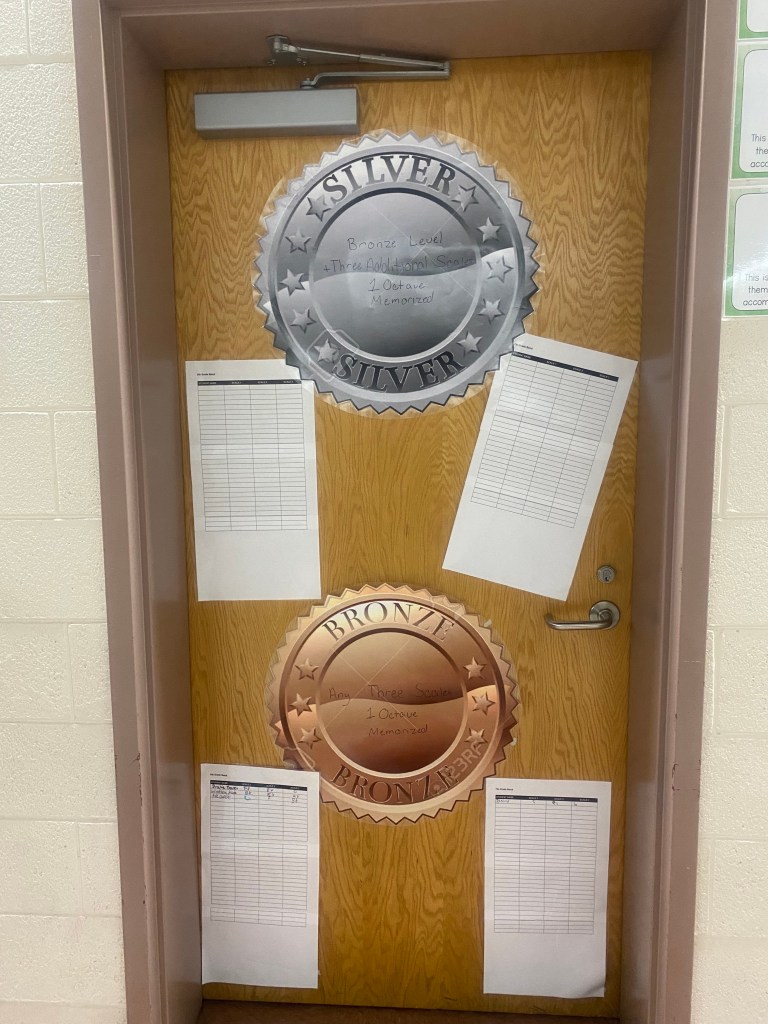
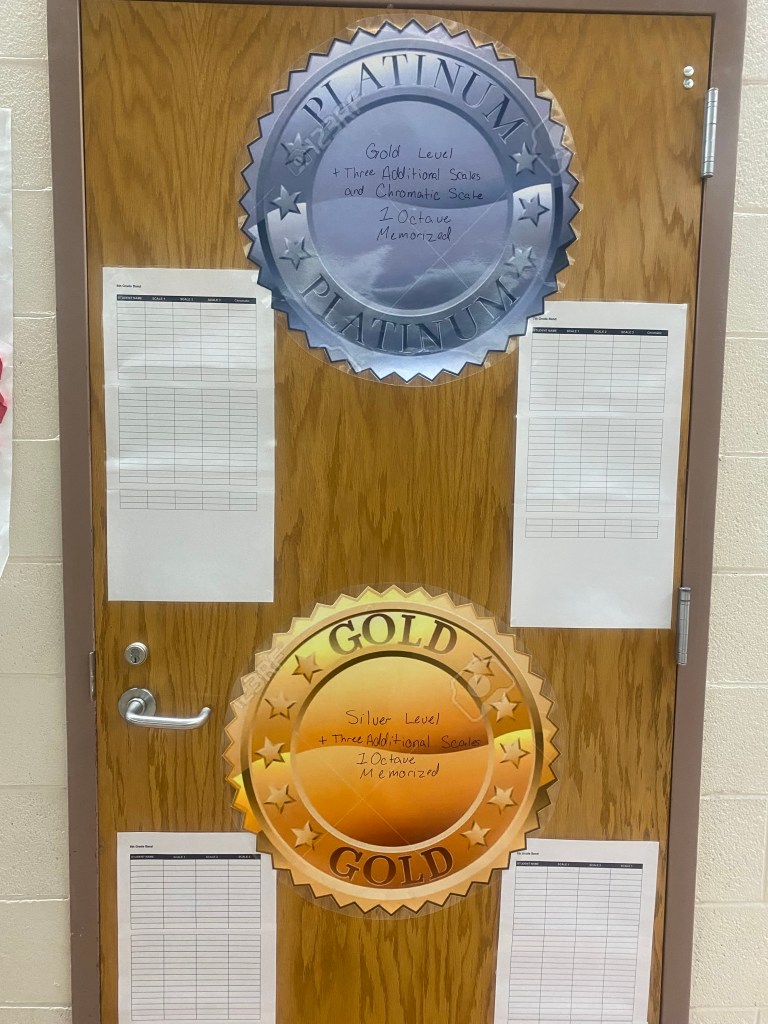
Each medal has the requirements to get into that club written on it. If you wanted to be fancy you could type it on the image, but I felt inspired and wanted to get this implemented quickly.
I’ve noticed that in the 8th grade band (more kids know at least one or two scales at this point) we are missing less notes and we are generally more sure of where our fingers go even if we’re only in our first year of band. 7th grade band is getting there! I finally have a student in the Bronze level and I think I will have a few more once I get the next resource out to all the students.
Scaffolded Scale Worksheets
I rolled these out with just my flute players to see if students generally understood what was being asked of them. My flute players are a great group to start these things with because I have some kids that understand everything, some kids who need a few repetitions to understand, and some kids who are in a different universe. They represent a wide spectrum of abilities and they put up with my shenanigans!
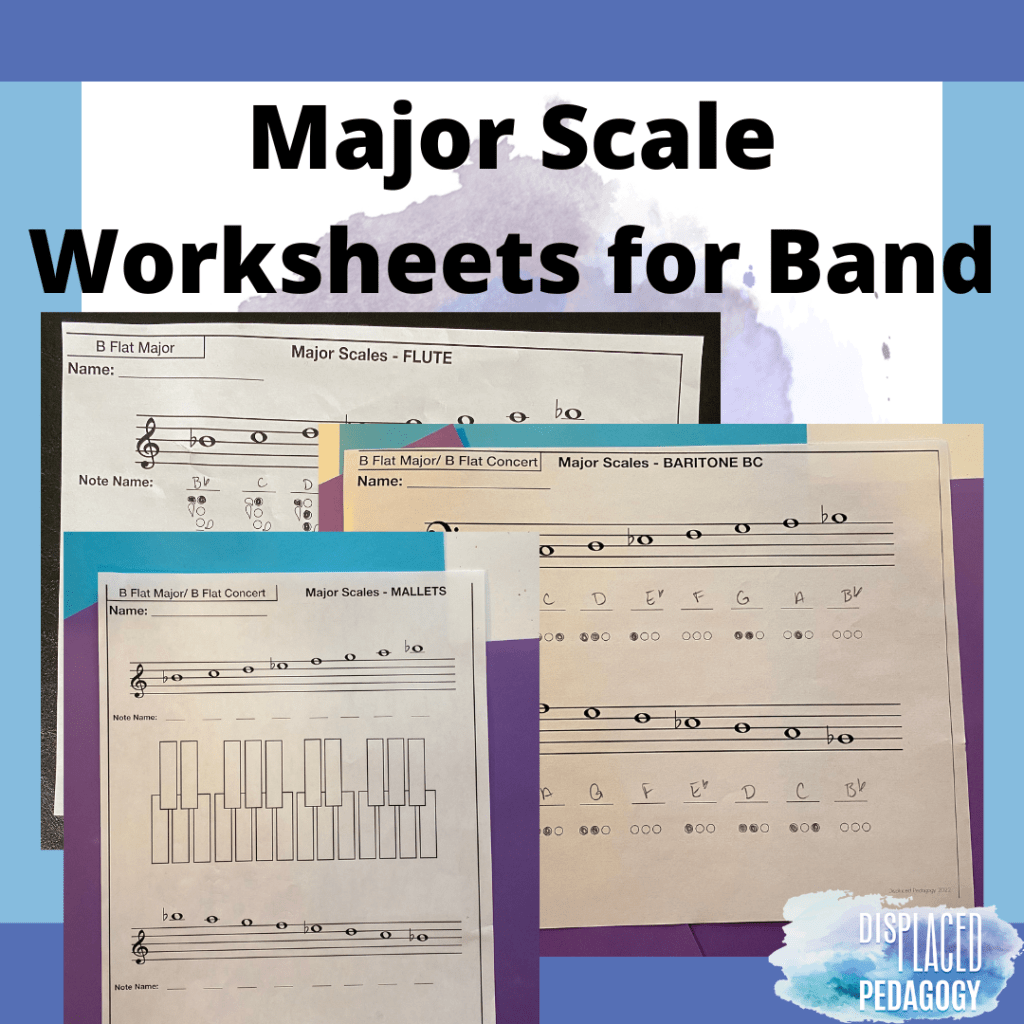
I don’t know what else to call these except for Scaffolded Scale Worksheets because I plan on making them assignments, and I just feel like it’s a clunky name for a resource. Anyways, these also turn into great resources for students that might have trouble with visual tracking or just can’t handle jumping back and forth between multiple documents to figure out a scale.
The scale is written out using accidentals and there is room for students to write note names underneath the notes on the staff. Before you come for me saying that they don’t need to label their notes, I know. But for my students this is probably their first time seeing music on a staff and I am encouraging them to work ahead, so there’s a fair chance we haven’t learned the note in class. I’m going to let them label their notes.
Under the note names is a blank fingering diagram where students can color in the diagrams and have the note on the staff, the note name, and the fingering for the note all available in front of them. There’s no more jumping back and forth from different pages and no more skipping notes on the fingering chart to find the correct fingering. I’ve put it all right there for the kids and I think my flute section is about to go for the Bronze, because they’ve been practicing their scale more after working on these sheets. I even have one student who has asked for more scales.
If you’re interested, I do have them uploaded as a bundle on Tpt. You can check that out here if you’re interested.
Chunking The Scales
My students get really freaked out when they see a whole scale and think that they have to learn and memorize the entire scale in one go. I’ve finally got them all trained to realize that they can find easy chunks and learn those first before they go on to the entire scale or musical line (because this advice works with our pieces and lines from the book).
We always start with the first three notes of the scale as the first chunk.
The next step we take is the five note chunk.
By this time my students are usually comfortable trying to learn and memorize the entire scale.
Helping my students look for and commit to these chunks has helped them feel more confident and be more independent when they are practicing their scales. I include scale chunks and melodic patterns into our daily warmups everyday so that the students gain more fluency with them as well.
At my school we use the Sound Innovations line of books. I have the warmup books in addition to the main book. I like these books because the warmups are all grouped together by scale. This means that when my 8th grade started learning a piece in C minor it was super easy to get several C minor warmups together and get them comfortable in that new key signature!
Of course, you don’t have to have this book series in order to get your students comfortable in a variety of keys. Any book series that takes them through a variety of keys will do just fine. Or, if you still have access to music notation software then writing out exercises will work perfectly as well!


 Displaced Pedagogy