

Whether you are looking for your first job or a new job a great resume and cover letter is a must! Your resume is either your very first, or one of your first impressions with your new school, so it has to be good in order to get that interview to make a better impression. That means you need all the correct information in the correct order and formatted in a visually pleasing manner.
I’ve gone through the wringer writing my own resume and now I have friends who come to me to help them write resumes because they know mine is really good. I’m going to share all the advice that I have to offer in this post and hopefully your resume will look amazing after reading this blog post.
The first half of the blog is going to go over what information you need to include and in what order, the second half is where I will give you all of my tips about formatting the resume so that it gets read.
What information should you put in your resume?
Education
Relevant experience
Leadership experience
Relevant skills
Awards and honors
Skills
Publications/ conference appearances
What order should your sections go in?
New Grads
Education
Relevant experience
Leadership experience
Relevant skills
Awards and honors
The reason that your sections should go in this order is because you just got out of school. You may not have very much relevant experience, and if you do it wasn’t a long term commitment. Administrators will also know that you’re fresh out of college and will want to know what type of relevant course work you completed.
Relevant experience for us music teachers is anything from band camps, private lessons, and summer camps. Make a list of all of those that you did and the year(s) and locations of each thing.
Were you in a fraternity, sorority, or other student organization? Talk about it, especially if you had a leadership position at any time while you were in college.
Relevant skills include knowing how to use GSuite or the Microsoft Suite effectively. Maybe you are a master at creating and maintaining budgets, maybe you weren’t good at planning instruction, but you were great at keeping students engaged in their learning. There are so many skills that you could pick from as a music teacher.
For Awards and Honors I wouldn’t list every single scholarship you got. List any music specific scholarships you were awarded. And then list honors you received through your student organizations or academic department.
Seasoned Teachers
Work experience
Education
Certifications
Leadership roles
Awards and honors
Skills
Publications/conference appearances
So the sections are flipped around a little bit to reflect that you have had a job now. List any and all jobs you’ve had in your entire career, we will brag about how awesome you are under each job heading.
Education will be similar to when you were a new teacher, you don’t have to go into as much detail because at this point admin cares way more about your practical experience than anything else.
List any and all extra certifications that are related to your job. I will be finished with Orff-Schulwerk Level III and will replace “Orff-Schulwerk Level II” with “Certified Orff-Schulwerk Instructor.” If you have the Google Level 1 training also list that. I personally wouldn’t list all the health and safety training that your school makes you do because that’s pretty standard stuff. But be sure to list anything that is music specific or isn’t a standard thing that almost every educator get certifications for.
This goes without saying, but if you were on any committees at your school or within a professional organization please list that. Treat this as a secondary work experience section.
For awards and honors as a seasoned teacher I would keep it to things that were awarded for a whole school year. For example, I was awarded Teacher of the Month for the month of February at my school. I am not going to list that on my resume because it isn’t a teacher of the year type of thing which is a bit more impressive. I will list that I was awarded several grants for professional development by my professional organizations, if I am selected as the Middle School Music Teacher of the Year by my MEA district I will list that. My cooperating teacher was just awarded Elementary Music Teacher of the Year from my state’s MEA, so that’s a real big deal and needs to be talked about.
If you’ve written anything that got published in an academic journal or industry journal then list the title and all that fun stuff. The same thing goes for any conference presentations that you’ve done. Listing these things on your resume shows that you are a true expert in the field and that you are in innovator in the field. We will go over formatting of all of this stuff in the second half, but seriously, list this kind of stuff!

Formatting Your Resume
Formatting is really important because you only get one page to fit all of this super important stuff. If your resume is too long or too text heavy it won’t even get read. And yes, there is currently a teacher shortage, but that’s only making admin and SBDM councils more weary and tired. Keep the resume light and text, but impactful.
Put your info in the page header
This is my protip because I have quite a few leadership roles, certifications, and other things that I would rather have take up space on my resume instead of my name and address. This is also helpful when your resume goes onto your back page; your personal information is on both pages automatically.

If you’re like me and have a lot that needs to go on a resume then this is a great “hack” and all you have to do is go to “Insert,” “Headers and Footers,” “Headers” and start typing. To insert the black circle like I did you need to go to “Insert,” “Special Characters,” then type “Circle” in the search bar.
Avoid large Chunks of text
No one is going to read all of that. The hiring committee will probably be interviewing people all day and has probably been looking at resumes and cover letters all day. They will not read your resume if if has giant chunks of text in it. Please break it up and create some white space.
Pick one font and stick with it
Between bolding, underlining, italics, and making slight changes to font size you truly do not need any more than one font. This will make your resume easier to format as well because you don’t have to remember which font went where and how you formatted it to look like a certain way. Creating a resume can also be stressful, so this way you wont have to spend a bunch of time wondering if the fonts look nice together.
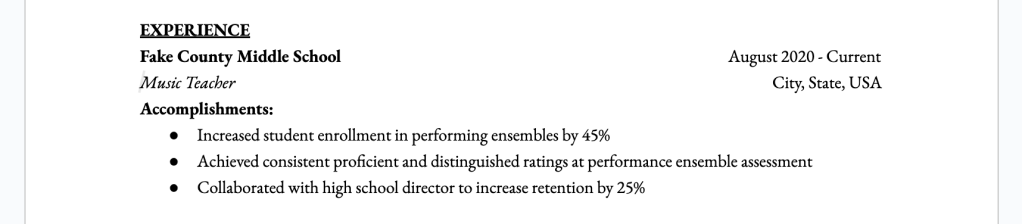
In the picture of my resume above, you can see that everything was done in one font and I just changed the text formatting a little for each different thing. Once I have established this formatting pattern once I’m just going to keep it nice and consistent through the entire resume and the bold text will keep drawing eyes to the big, broad information that is necessary.
Use “Power Words” to make a large impact
Which sounds better?
- Facilitated student learning of 10-minutes of music and movement for local, district, and state performance assessments.
Or
- Taught students music for 10-minute marching band show.
I bet you picked number one, didn’t you?
I don’t know why, but people reading resumes love “legal-ese” even though no one in the room is a lawyer. I don’t know all the specifics about power words, I just know that they are important and that they should come at the beginning of the bullet point. For an excellent guide about power words to use click here.
General considerations
One page or less
The shorter the better, so to speak. If you have one page all on the front then thats great. I had to go onto the back page, which people hardly look at, so i keep my least important stuff the back. The stuff on the back is still important and shows a more complete look about me as a teacher, so thats why I keep it there; however, it’s not going to be make or break if no one looks at it.
Use bullet points (but not to many)
The rule of thumb that I am aware of is to include 1-3 bullet points to explain what you did in a role. So don’t just list that you had a job. List that job then brag about 1-3 major accomplishments from that job.
Reverse chronological order
This is standard across all resumes in all fields. Every section needs to be in reverse chronological order! That means that your student teaching experience should be first under relevant experience new grads! Unless of course you have a summer camp position that you will be working after summer camp.
If you have two positions that ended at the same time (two leadership positions in different organizations) then you would list the one that started later, and underneath it the position you started earlier.
Have someone else proof it… then ask someone else
When I made my resume for grad school applications I had my advisor look over my resume. He absolutely tore it to shreds and told me to edit everything and bring it back to him.
I made the edits.
I took my resume to him again.
And he tore it to shreds again. Then he said to take it to my research advisor (i did two different undergraduate research projects; she was my mentor for both projects)
I made the edits and took my resume to my research advisor.
She also tore my resume apart. Then said to make edits and take it to the instrumental head of department at my university.
So I made more edits. I took my resume to the third different professor. I waited anxiously as he edited my resume even more. He was correcting all of the tiniest details and making all of the edits using english language rules that I didn’t even know existed!
But he said that my resume was really good and that I needed to make the edits and take my resume to the university career center for one last look.
So I made probably my 5th set of edits to this resume. I would like to say it wasn’t bad to start with, but at this point I was so tired of worrying about formatting and punctuation and font size that honestly, maybe my resume did start out that bad.
I wouldn’t know how bad it was without these people because this was my first resume that I’ve ever written! Anyway, this isn’t the point. I made more edits. I took my resume to the career center on campus.
The career center lady said “wow this is a really good resume! Which of this stuff is from high school?” When i responded that everything in my resume was from college she was genuinely impressed. I presented her with a one page front and back resume that was exclusively college experiences. She had no notes, but she gave me a booklet with other formats to explore for my professional resume, and I have never been more relieved!


 Displaced Pedagogy