

Scales.
The dreaded musical building block of the beginning band. You and I know how important scales are to being a great musician, but our students don’t. If you’re like me and you love scales (I seriously love playing scales) then you might struggle to also get students to practice the scale.
I actually noticed that some of my students were really struggling to play scales one day and I made these Major Scale Worksheets to help them be more successful. I am happy to report that my students all know the required scales inside and out and many of my very motivated students began asking me for these worksheets so they could work ahead on their scales.
What are the Major Scale Worksheets
The Major Scale Worksheets are designed to help students that struggle with visual tracking feel more successful while they are practicing scales. One day I noticed that I had a lot of very motivated students who wanted to get into the Scales Club in my school that were just struggling. One day I decided to stand close, but not too close, to a student who was practicing so I could just observe what they were doing without stressing them out.
In just watching this student I realized that having to look at a note on the staff, then finding that note on a fingering chart, then placing the fingers correctly, was a HUGE struggle for many of my students. So I wracked my brain trying to figure out if any tools existed that combated this problem, and after much searching, I couldn’t find anything. I knew that if I wanted to ease this burden for my students then I would have to make the tools myself.
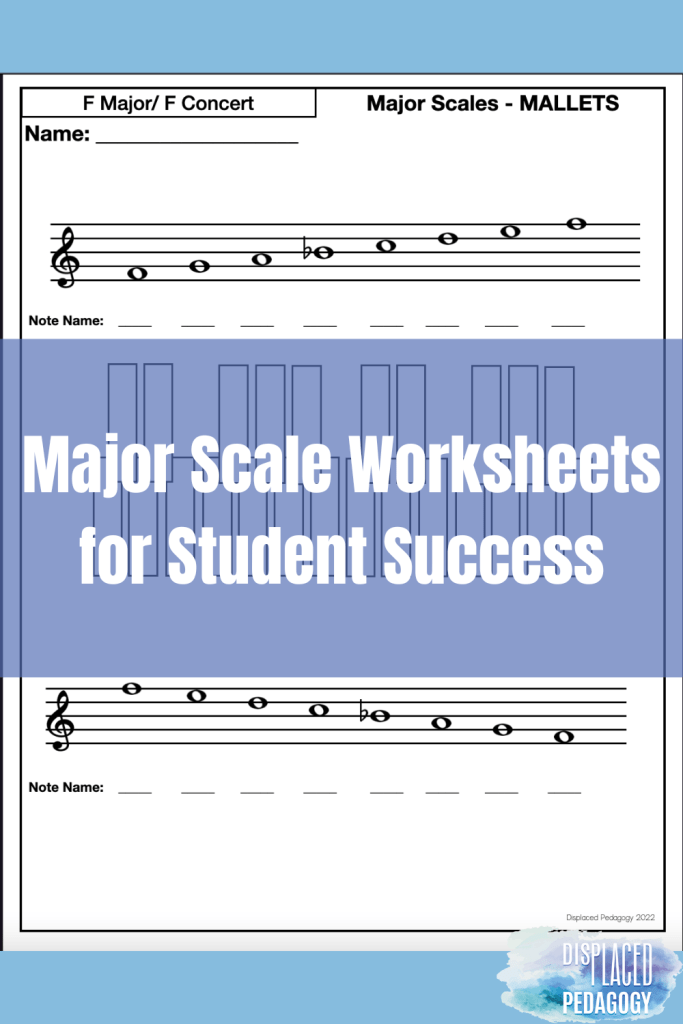
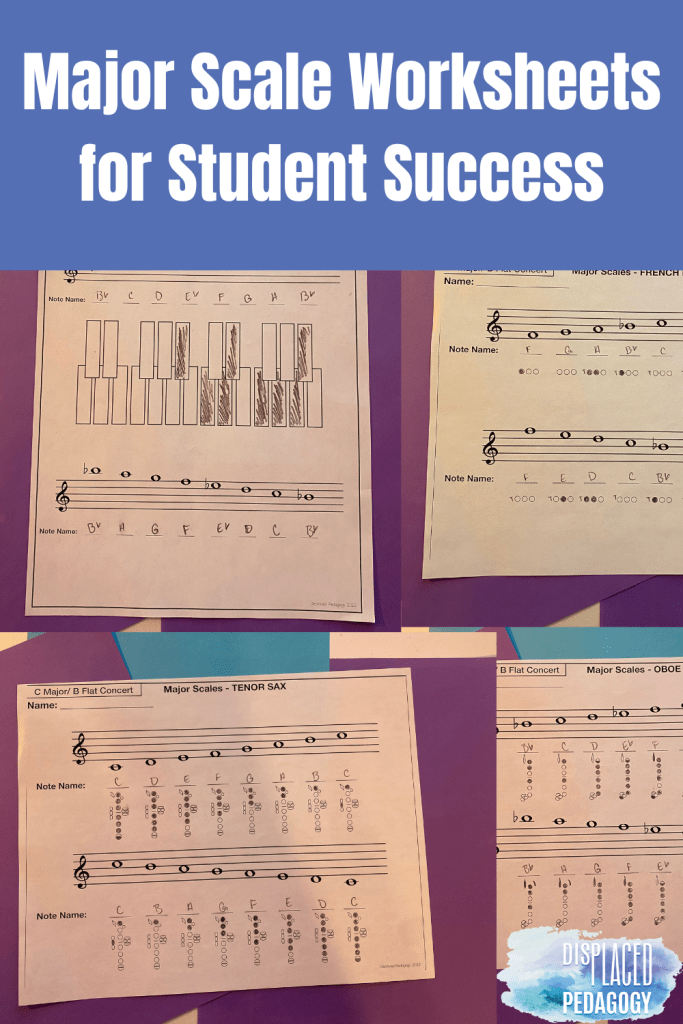
As you can see in the picture above, I wrote out the major scale using accidentals then I left a space for students to write their note names underneath the note. Under that is where the magic happens. I placed a blank fingering diagram under the note name space so that my students wouldn’t have to look between multiple pieces of paper anymore.
I tested this out with my one kiddo I noticed struggling the most (the same kid I initially watched in the scenario above) and after a few days he was doing so much better with that scale!
Why Should You Use Them in Your Classroom
I’m definitely biased, but I think these are awesome! I teach in a low income, high needs school and many of my students come to me with little (or absolutely no) prior musical experience. So I am trying my best to rehab an elementary education, all while teaching my kids all the things they need to know and beginning instrumentalists.
These worksheets are a great visual resource for your students who struggle to remember and synthesize a lot of information on the spot. If you’re in my situation it helps your kids who just can’t handle looking between multiple pieces of paper.
It also keeps them from writing in their band books; because they are writing on something else.

How Can You Use These in Your Classroom
Formative Assessment on Required Scales
There are a few scales that I make required for every student to learn. Those are the B-Flat Concert Scale and G Minor. We learn all of those notes well within our first year, so those are the scales they should have memorized and ready to play. (If we get further along or have a piece in a different key then that becomes a required scale too, but I’m getting away from the point).
I make this a formative assessment before any scales playing tests so that students can’t look at me and say that they didn’t know the notes or fingerings. It’s like a pre-check to make sure they know all the information and have a place to find it before they perform it as a grade.
You do what you want when grading, but I give one point per piece of information that they have to provide on the sheet. If a student misses an accident I take away a half point. If the student misses a fingering by one or two keys they miss the point. All incorrect answers have to be redone until correct.
You can visually monitor woodwind scales.
If you are like me and you’re in the situation where you teach all the instruments at the same time by yourself, then this can help your tired teacher brain visually see if your students are going to learn the correct fingerings before you set them loose.
Clarinet fingerings are not my forte as a trombone player, but I know all the rules for which fingerings to pick when. My students don’t yet. Or maybe sometimes they just forget because they use a different fingering more often. Either way, I’m helping them play the scale in the easiest way possible, which means faster success and less frustration!
Use this as a Memory Test
Does your administration require you to give paper and pencil tests like mine does? Give this as a quiz to end the B-Flat Concert unit!
Use this as part of a Substitute Plan
I don’t let my students practice in my room when I have a substitute. I know, it’s a controversial opinion. I have a lot of…behaviors… in my classes and I don’t want a substitute to be responsible for filing an incident report for injuries caused by flying equipment and I don’t want to pay for repairs when I didn’t witness the accident to see if it was intentional or not. (I have good classroom management, but I have kids that try to pull over everything on substitutes).
To the main point though, I leave a paper and pencil assignment every time I am out for the day. I’ve got students trained on how to complete this and subs love that they don’t have to explain how to complete these worksheets because I rarely get a sub with a music background. I had one once who called a friend that plays organ to answer questions so he could help out my kids!
The sky’s the limit with these! If you think that you would find these Major Scale Worksheets helpful you can purchase them from my Tpt store or you can take screenshots form a music notation software and use this fingering diagram builder.
If you notice any errors at all please let me know! You can contact me at displaced.pedagogy@gmail.com or leave a comment on Tpt. I am a trombone player, so it’s very possible that I might have goofed up on the woodwind worksheets. My students don’t always catch my mistakes because they are so used to them!

 Displaced Pedagogy